
AC Surge Protection Device Manufacturer
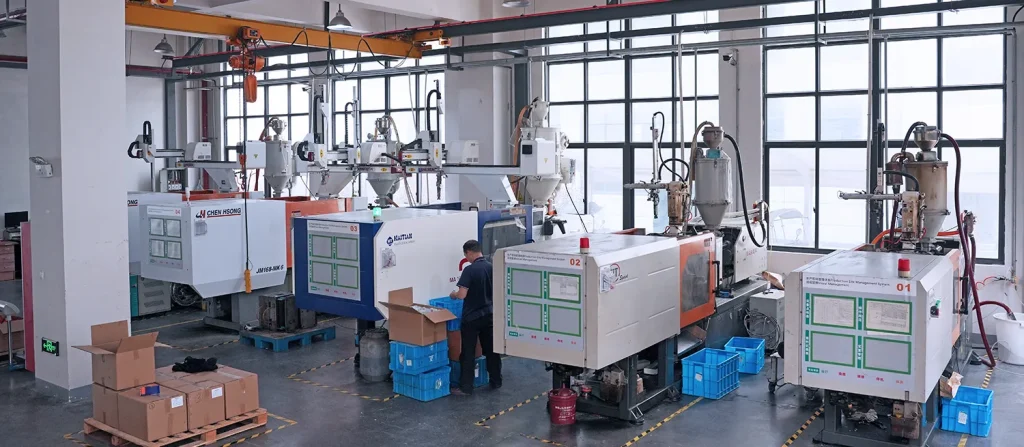
As a leading manufacturer of surge protection devices (SPDs) in China, CUAJE is committed to producing high-quality, pluggable DIN-rail AC SPDs. With a deep understanding of industry standards and regulations, we manufacture millions of SPDs annually. Our dedicated teams focus on delivering SPDs with exceptional service and quality, closely aligned with market demands.
AC Surge Protection Device SPD Types
DIN-Rail AC SPD for Single and Three-Phase Systems
Surge protection devices (SPDs) are classified into three types according to IEC 61643-11and EN 61643-11 standards, each offering protection against malfunctions and defects caused by overvoltages:
Type 1 / Class I / Class B:
Type 1 / Class I / Class B: Provides protection against direct lightning strikes and high-energy surges.
Type 2 / Class II / Class C:
Designed for use in distribution boards to protect against medium energy surges.
Type 3 / Class III / Class D:
Used for sensitive electronic equipment, offering protection against low-energy surges.

AC Surge Protection Device (SPD)
DIN-Rail AC SPD for Single and Three Phase – OBV10-I-25 Series
The OBV10-I-25 Series DIN-Rail Type 1 AC Surge Protection Device (SPD) is designed as the optimal solution for safeguarding service entrances in industrial settings, particularly those equipped with existing lightning protection systems or mesh cage configurations. This Surge Protection Device SPD is ideal for both single-phase and three-phase systems, offering reliable protection against surges.

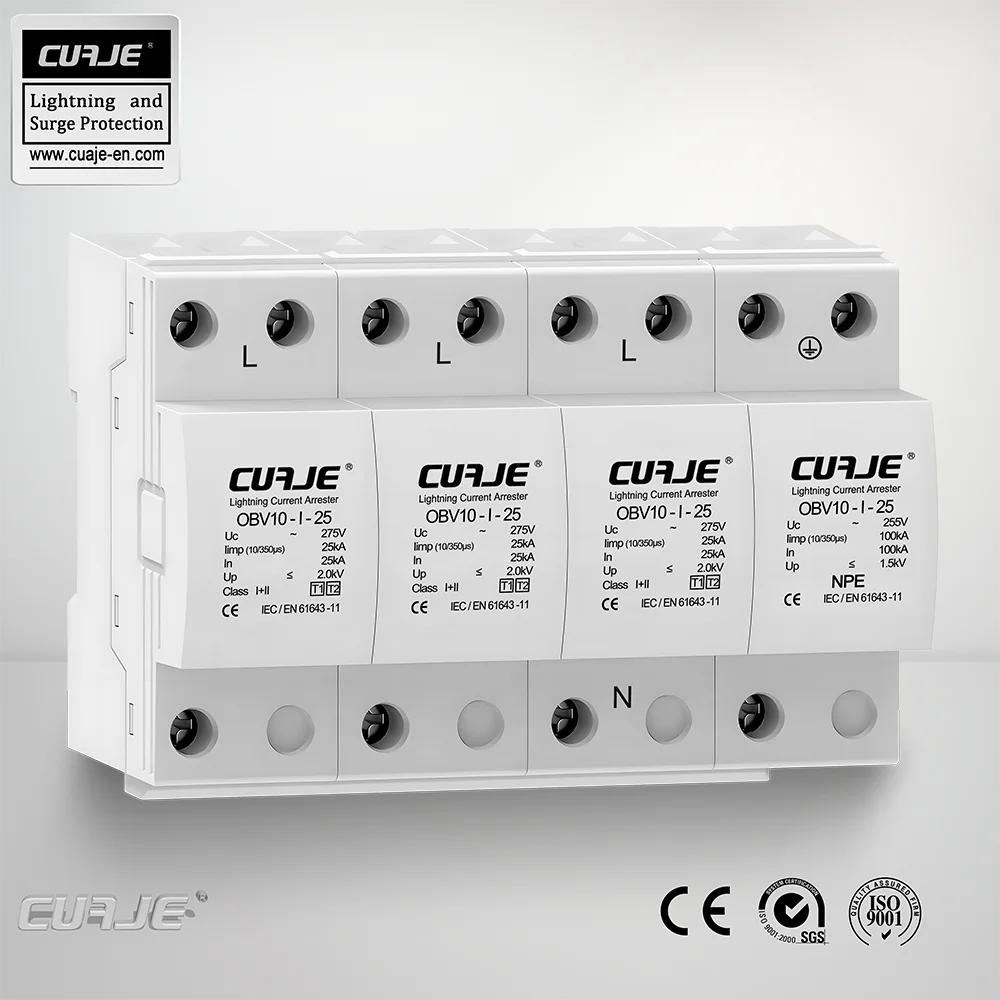
OBV10-I-25-275/4+0
Type 1 AC SPD for 3 phase TN-S networks
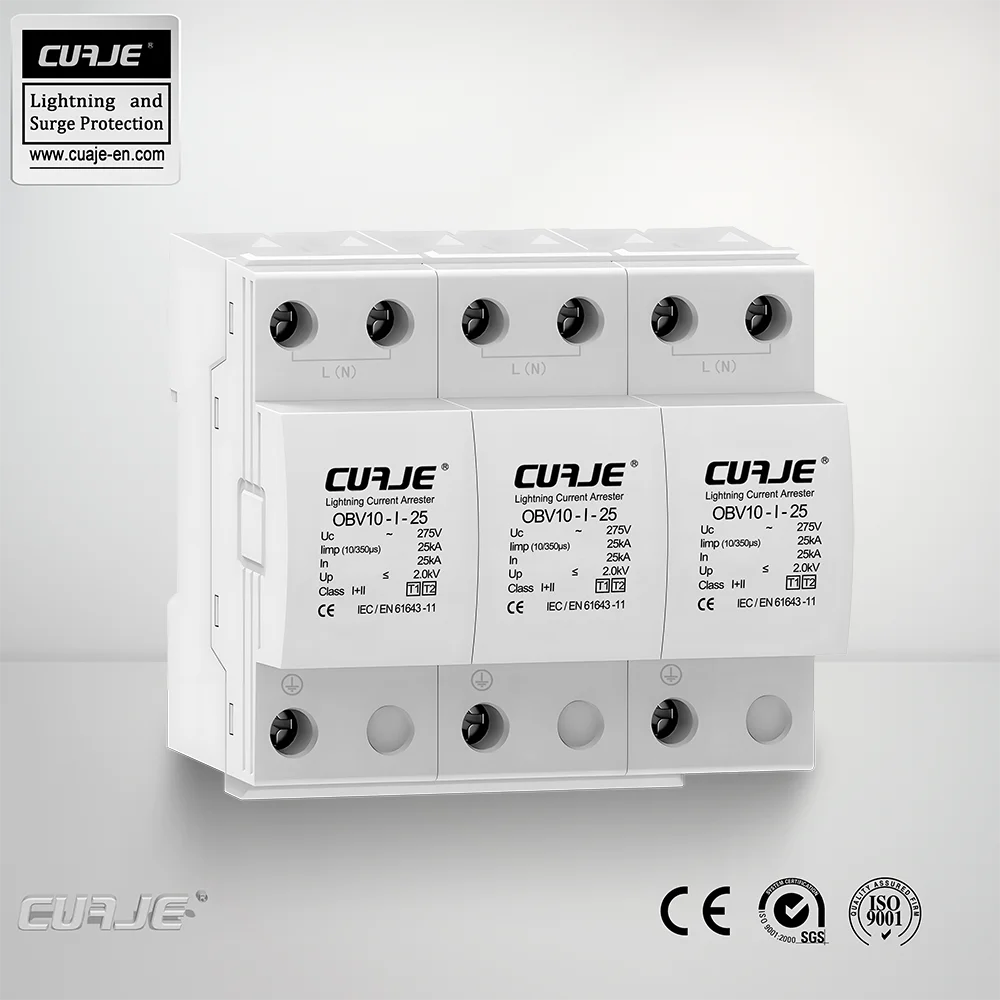
OBV10-I-25-275/3+1
Type 1 AC SPD for 3 phase TT&TN-S networks
OBV10-I-25-275/3+0
Type 1 AC for 3 phase TN-C networks
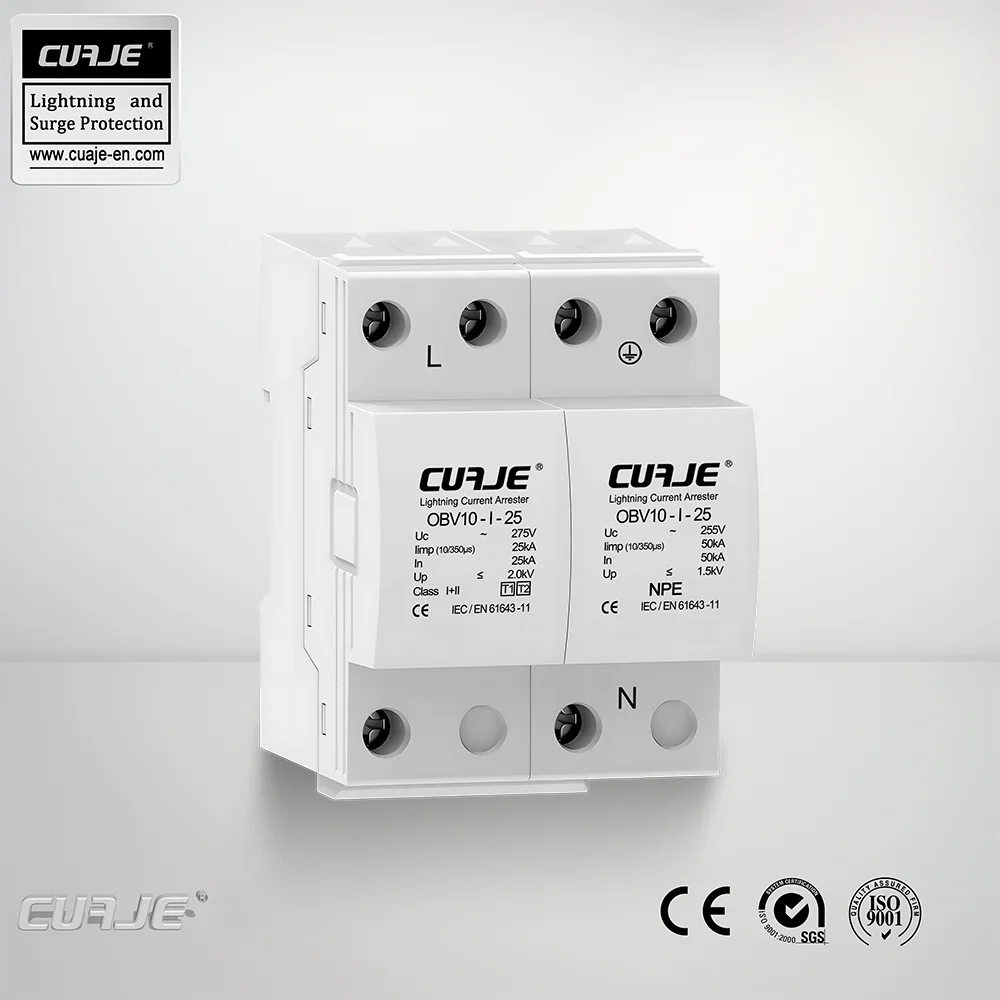
OBV10-I-25-275/1+1
Type 1 AC SPD for single phase TT and TN-SS networks
Type 1 AC Surge Protection Device (SPD)
DIN-Rail AC SPD for Single and Three Phase – OBV10-I-25 Series
The OBV10-I-25 series DIN-Rail Type 1 AC Surge Protection Device (SPD) is specifically designed for areas with high lightning activity, where the risk of significant surge currents or direct lightning strikes is elevated
Specification:
Nominal voltage Un: 120V 230V 400V
Max. continuous operating voltage Uc: 150V 275V 320V 385V 440V
Type 1 / Class I / Class B
Nominal voltage Un: 120V 230V 400V
Impulse discharge current (10/350 μs) Iimp = 25kA @ Type 1
Nominal discharge current (8/20 μs) In = 25kA @ Type 2

Wiring Diagram & Installation
DIN-Rail AC SPD for Single and Three Phase – OBV10-I-25 Series
The OBV5-I-25 Series DIN-Rail Type 1 AC Surge Protection Device (SPD) is designed for both single and three-phase systems and is equipped with a 10/350 µs lightning current waveform for surge protection.
The DIN-Rail Type 1 AC Surge Protection Device (SPD) should be installed at the main circuit breaker of the load center, such as the main distribution board.
Type 1+2 AC Surge Protection Device SPD
DIN-Rail AC SPD for Single and Three-Phase – OBV5-B60 Series
This DIN-Rail Type 1+2 AC surge protection device (SPD) is designed to safeguard electrical installations from lightning strikes. It effectively absorbs and redirects the surge current caused by lightning, preventing it from reaching and damaging the connected equipment.

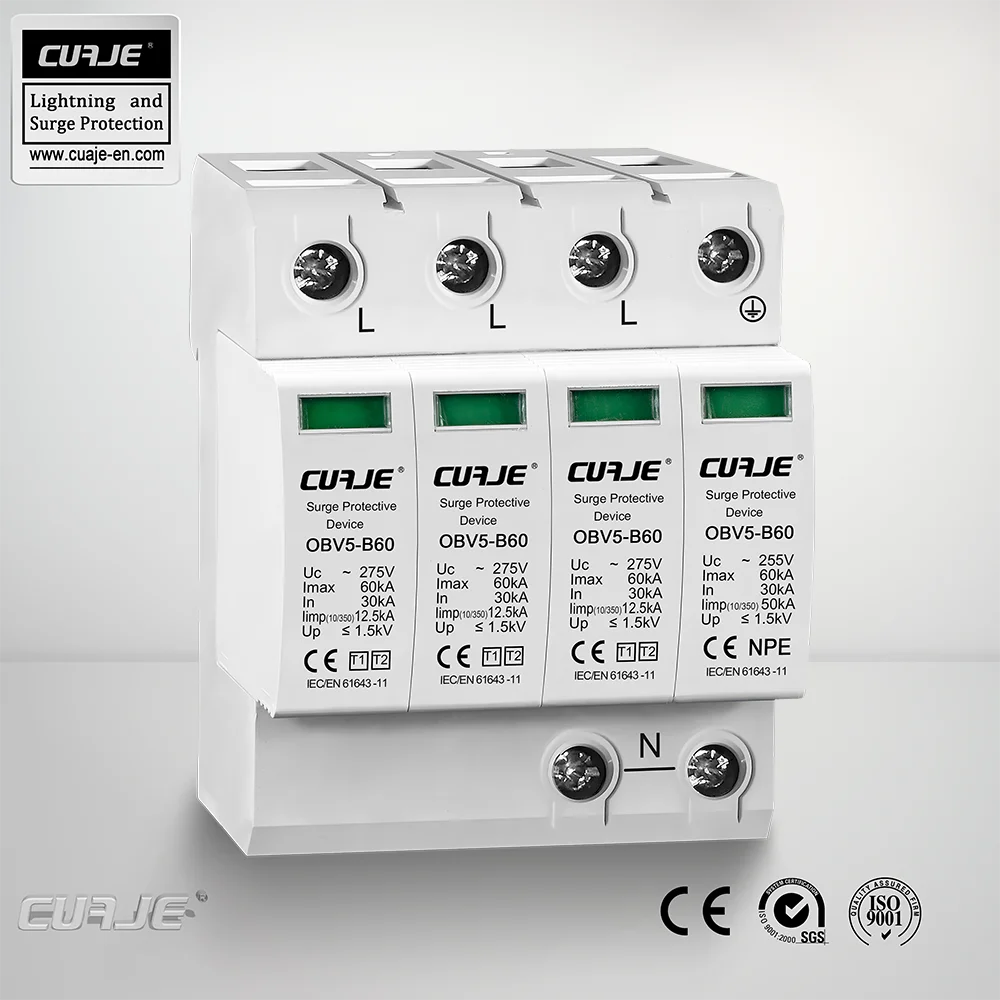
OBV5-B60-275/4+0
Type 1+2 AC SPD for 3 phase TN-S networks
OBV5-B60-275/3+1
Type 1+2 AC SPD for 3 phase TT and TN-S networks

OBV5-B60-275/3+0
Type 1+2 AC for 3 phase TN-C networks
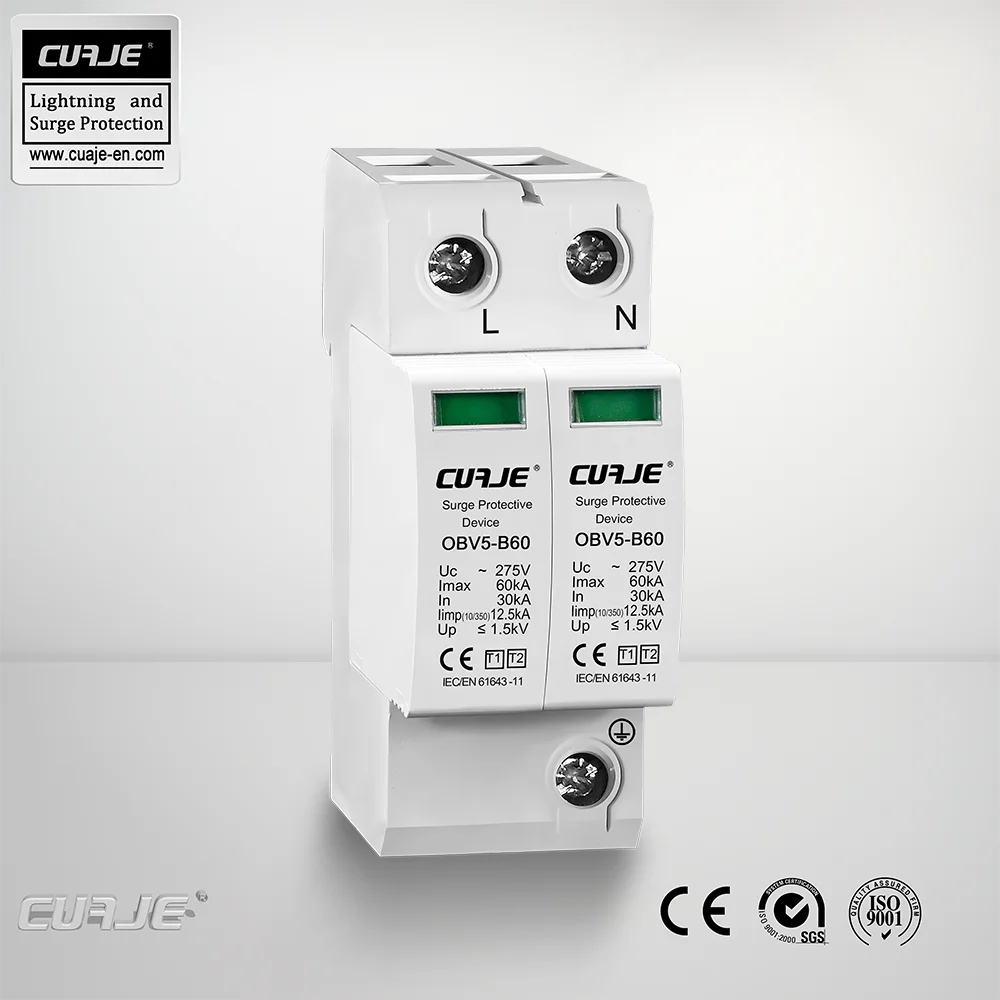
OBV5-B60-275/2+0
Type 1+2 AC SPD for single phase TN-S networks
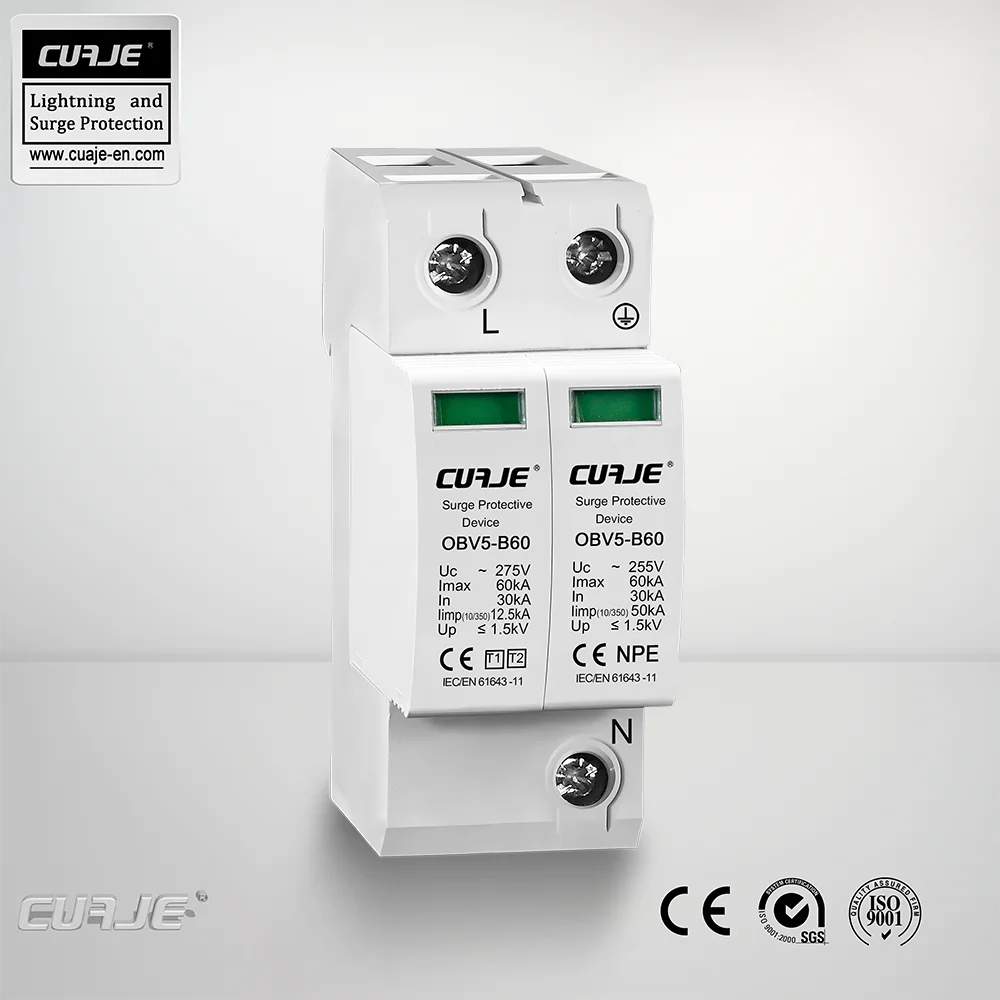
OBV5-B60-275/1+1
Type 1+2 AC SPD for single phase TT and TN-S networks

OBV5-B60-275/1+0
Type 1+2 AC SPD for single phase TN-S, TN-C, TT (only L-N)
Type 1+2 AC Surge Protection Device (SPD)
DIN-Rail AC SPD for Single and Three-Phase Systems – OBV5-B60 Series
The OBV5-B60 Series Type 1+2 AC Surge Protection Device is a DIN-rail mounted solution designed to safeguard all electrical installations from lightning strikes. It effectively discharges the surge current generated by lightning and prevents it from reaching and damaging connected equipment, ensuring the protection of your system. Suitable for both single-phase and three-phase configurations, this Surge Protection Device (SPD) provides comprehensive surge protection for a wide range of applications.
AC Type 1+2 Surge Protection Device (SPD) is characterized by a 10/350 µs and 8/20 µs lightning current waveform.
Specification:
Nominal voltage Un: 120V 230V 400V
Max. continuous operating voltage Uc: 150V 275V 320V 385V 440V
Type 1+2 / Class I+II / Class B+C
Nominal voltage Un: 120V 230V 400V
Impulse discharge current (10/350 μs) Iimp = 12.5kA @ Type 1
Nominal discharge current (8/20 μs) In = 30kA @ Type 2
Max discharge current (8/20 μs) Imax = 60kA @ Type 2
Protective elements: Metal Oxide Varistor (MOV), Gas Discharge Tube (GDT)
Wiring Diagram & Installation
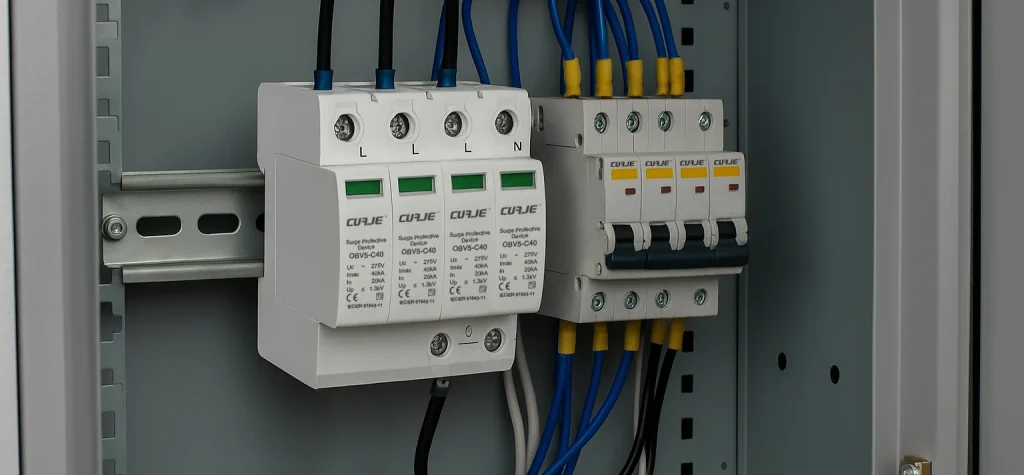
DIN-Rail AC SPD for Single and Three-Phase – OBV5-B60 Series
The OBV5-B60 Series AC Type 1+2 Surge Protection Device (SPD) is installed at the origin of the AC installation, providing reliable surge protection against lightning and transient voltage spikes. It is suitable for both single-phase and three-phase systems, ensuring comprehensive defense at the entry point of the electrical installation.
Type 1+2 AC Surge Protection Device SPD
DIN-Rail AC SPD for Single and Three-Phase – OBV5-B50 Series
The housing of the Type 1+2 DIN-Rail AC surge protection device (SPD) features a modular plug-in design.

OBV5-B50-275/4+0
Type 1+2 AC SPD for 3 phase TN-S networks

OBV5-B50-275/3+1
Type 1+2 AC SPD for 3 phase TT and TN-S networks
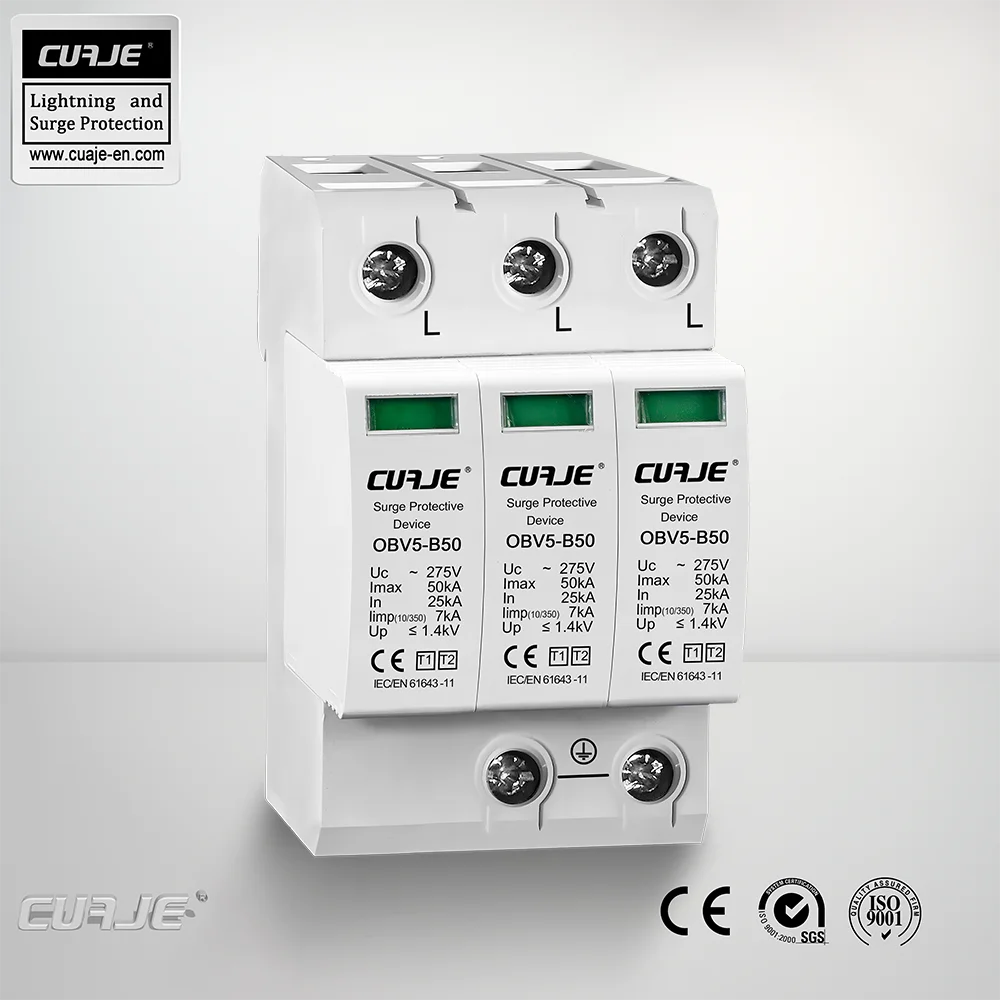
OBV5-B50-275/3+0
Type 1+2 AC for 3 phase TN-C networks
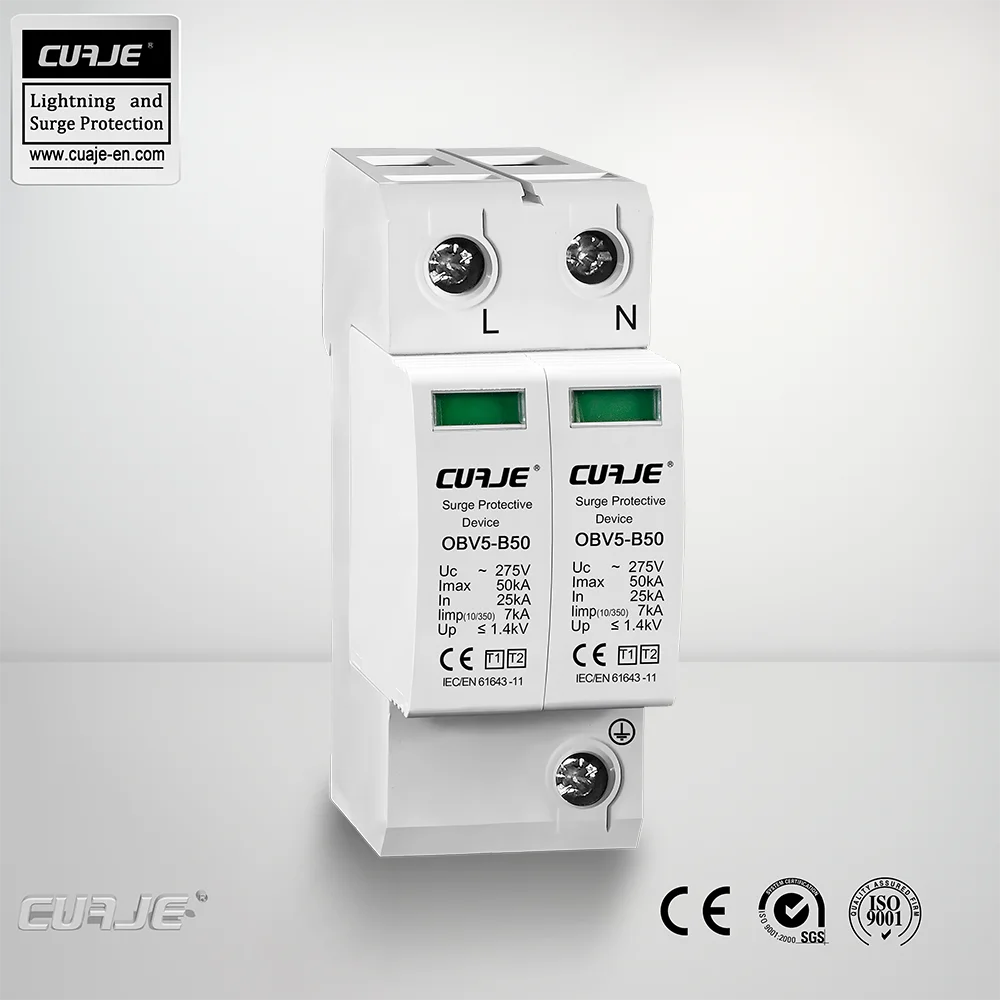
OBV5-B50-275/2+0
Type 1+2 AC SPD for single phase TN-S networks
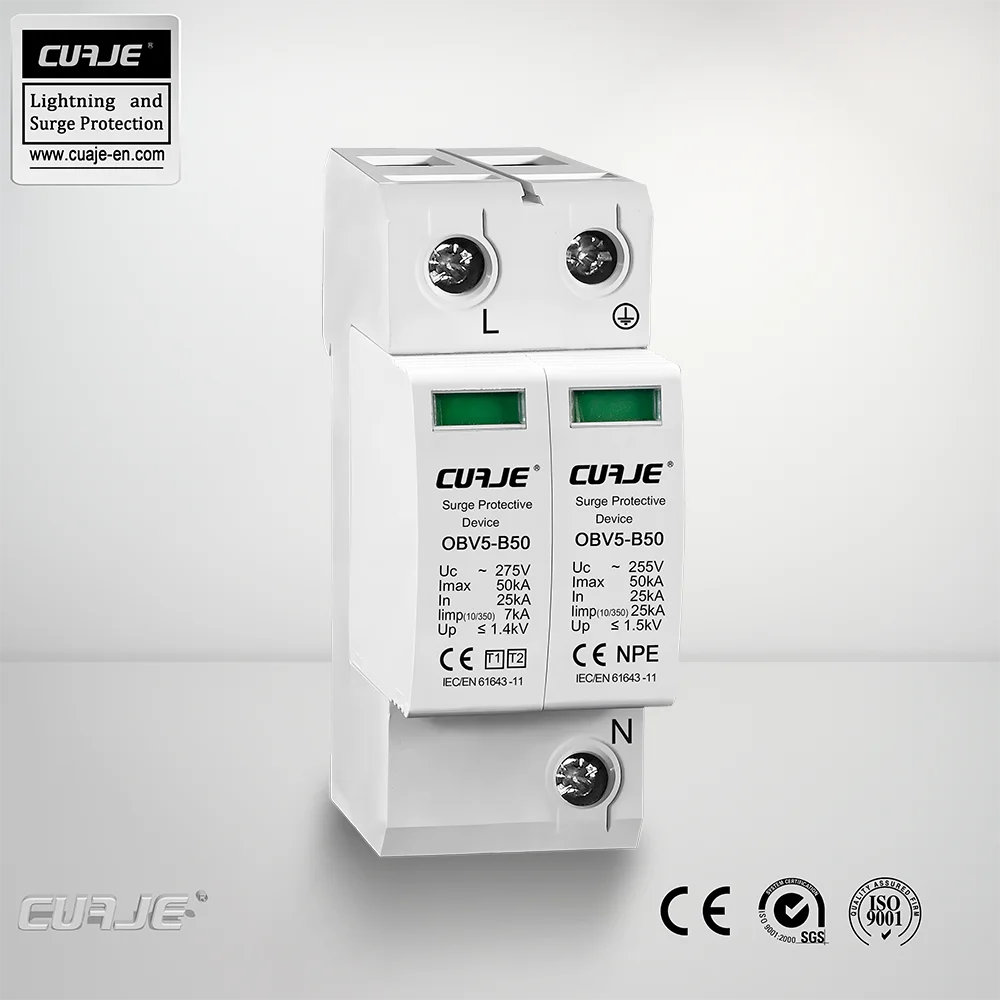
OBV5-B50-275/1+1
Type 1+2 AC SPD for single phase TT and TN-S networks
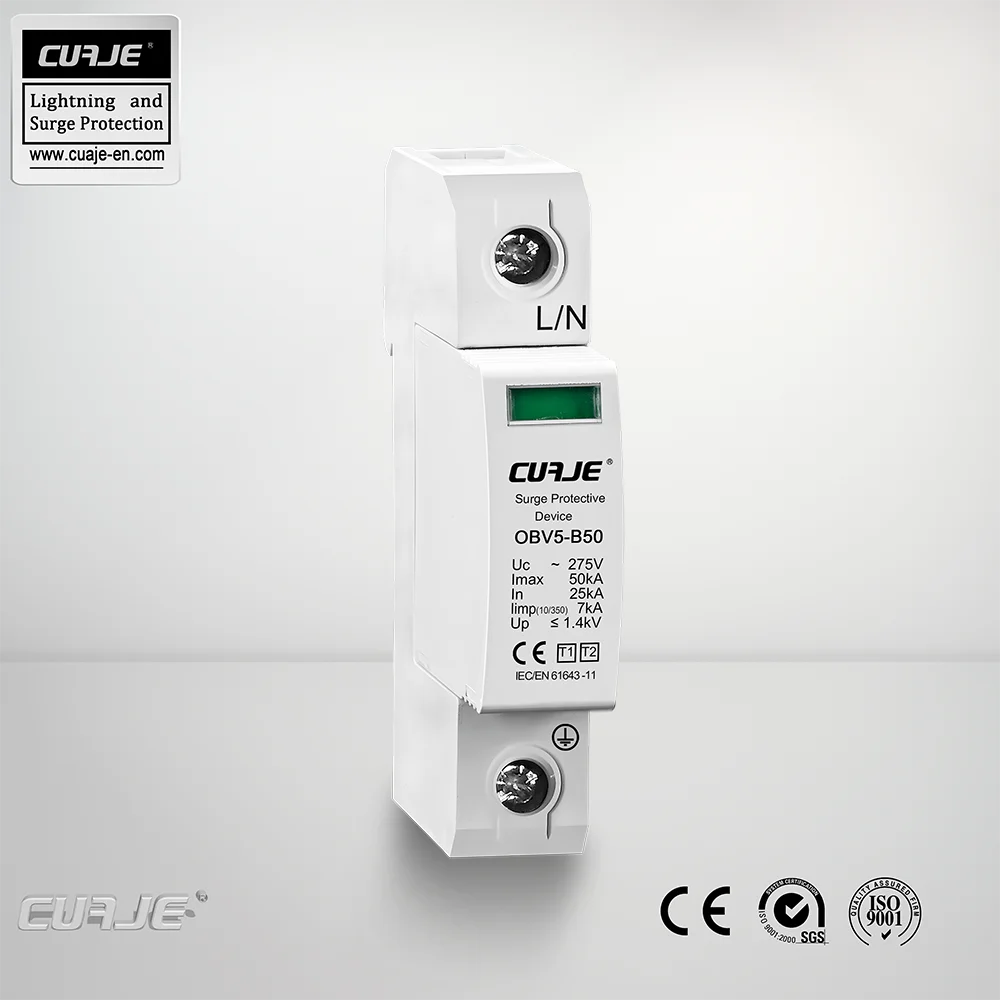
OBV5-B50-275/1+0
Type 1+2 AC SPD for single phase TN-S, TN-C, TT (only L-N)
Type 1+2 AC Surge Protection Device (SPD)
DIN-Rail AC SPD for Single and Three-Phase Systems – OBV5-B50 Series
The DIN-Rail AC Type 1+2 surge protection device SPD OBV5-B50 series utilizes Metal Oxide Varistor (MOV) and/or Gas Discharge Tube (GDT) technologies to safeguard electrical equipment against AC power surges.
Specification:
Nominal voltage Un: 120V 230V 400V
Max. continuous operating voltage Uc: 150V 275V 320V 385V 440V
Type 1+2 / Class I+II / Class B+C
Nominal voltage Un: 120V 230V 400V
Impulse discharge current (10/350 μs) Iimp = 7kA @ Type 1
Nominal discharge current (8/20 μs) In = 25kA @ Type 2
Max discharge current (8/20 μs) Imax = 50kA @ Type 2
Protective elements: Metal Oxide Varistor (MOV), Gas Discharge Tube (GDT)
Wiring Diagram & Installation
DIN-Rail AC SPD for Single and Three-Phase – OBV5-B60 Series
These AC Type 1+2 surge protection device SPD series are intended for multi-pole connection, offering protection for single-phase, 3-phase, and 3-phase+Neutral AC networks, as well as TN-C, TN-S, TN-C-S, TT, and IT power supply systems.
Type 2 AC Surge Protection Device (SPD)
DIN-Rail AC SPD for Single and Three-Phase – OBV5-C40 Series
The OBV5-C40 Series AC Type 2 Surge Protection Device (SPD) features an 8/20 µs lightning current waveform and is specifically designed to protect electrical systems from transient overvoltages. These devices are ideal for installation at the service entrance of low voltage systems or near sensitive equipment, ensuring reliable protection against surges. The OBV5-C40 series is suitable for both single-phase and three-phase systems.

OBV5-C40-275/4+0
Type 2 AC SPD for 3 phase TN-S networks

OBV5-C40-275/3+1
Type 2 AC SPD for 3 phase TT and TN-S networks
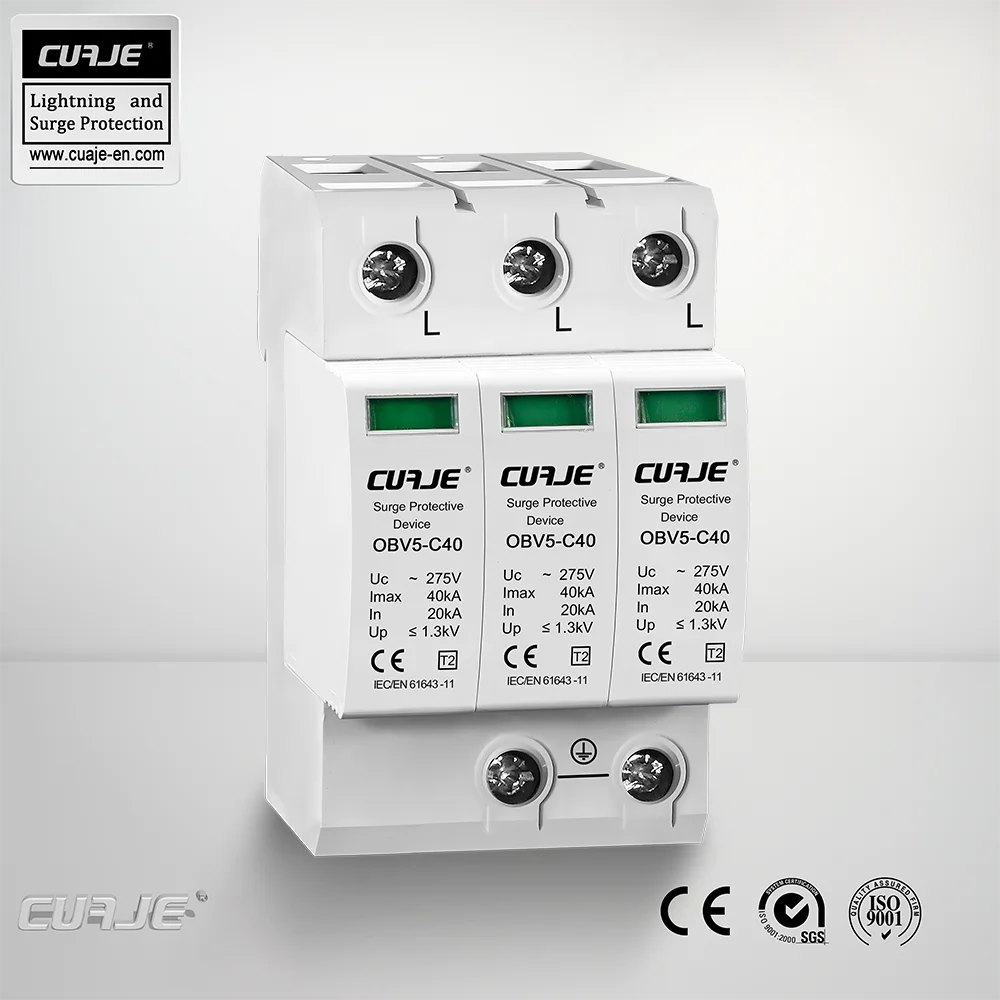
OBV5-C40-275/3+0
Type 1+2 AC for 3 phase TN-C networks

OBV5-C40-275/2+0
Type 2 AC SPD for single phase TN-S networks

OBV5-C40-275/1+1
Type 2 AC SPD for single phase TT and TN-S networks
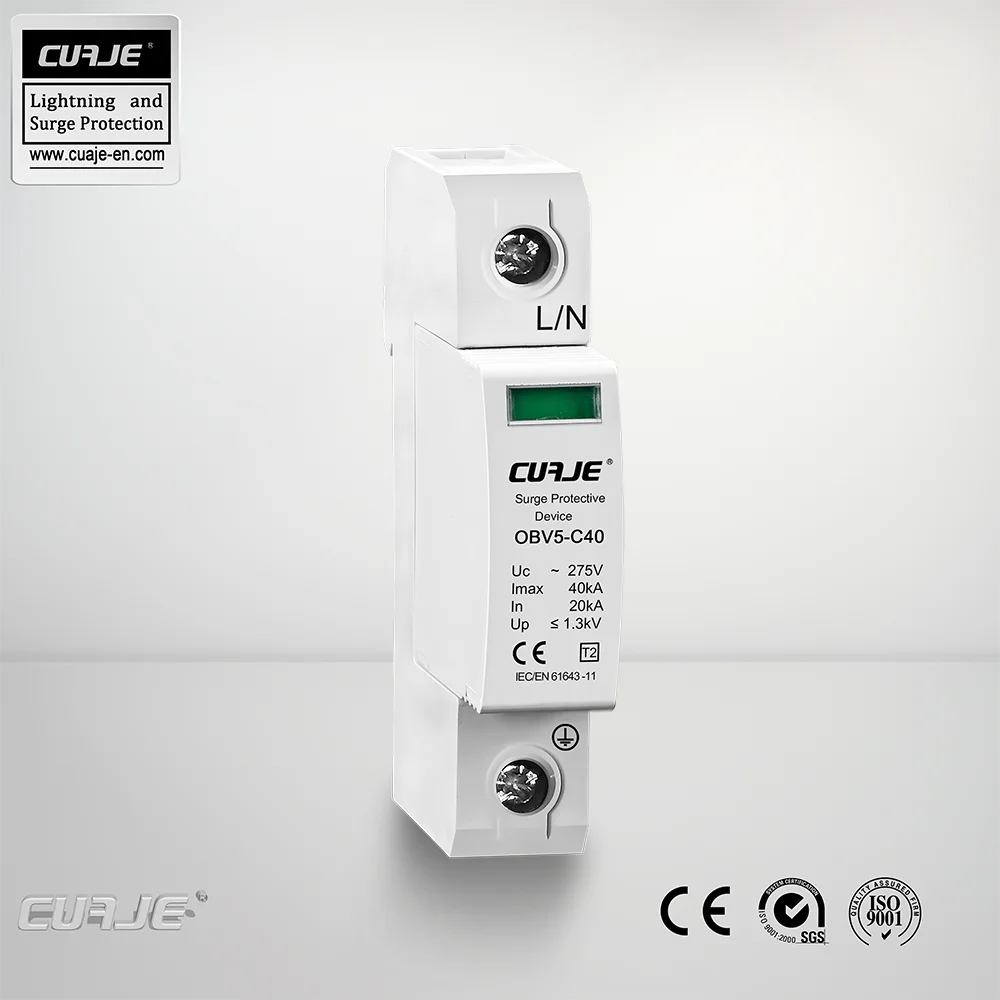
OBV5-C40-275/1+0
Type 2 AC SPD for single phase TN-S, TN-C, TT (only L-N)
Type 2 AC Surge Protection Device SPD
DIN-Rail AC SPD for Single and Three-Phase – OBV5-C40 Series
The OBV5-C40 Series AC Type 2 Surge Protection Device (SPD) is typically installed in sub-distribution panels or machine control cabinets. Designed for indoor use, it can also be installed in a waterproof enclosure for outdoor applications, providing reliable surge protection for both single-phase and three-phase systems.
Specification:
Nominal voltage Un: 120V 230V 400V
Max. continuous operating voltage Uc: 150V 275V 320V 385V 440V
Type 2 / Class II / Class C
Nominal discharge current (8/20 μs) In = 20kA @ Type 2
Max discharge current (8/20 μs) Imax = 40kA @ Type 2
Protective elements: Metal Oxide Varistor (MOV), Gas Discharge Tube (GDT)
Wiring Diagram & Installation
DIN-Rail AC SPD for Single and Three-Phase – OBV5-C40 Series
The OBV5-C40 Series AC Type 2 Surge Protection Device (SPD) is typically installed in sub-distribution panels or machine control cabinets. Designed for indoor use, it can also be installed in a waterproof enclosure for outdoor applications, providing reliable surge protection for both single-phase and three-phase systems.
Type 3 AC Surge Protection Device SPD
DIN-rail AC SPD – OBV5-D10 series
AC Type 3 Surge Protection Device (SPD) is characterized by a combination of voltage waves (1.2/50 μs) and current waves (8/20 μs).
OBV5-D10-275/2+0
Type 3 AC SPD for single phase TN-S networks
OBV5-D10-275/1+1
Type 3 AC SPD for single phase TT and TN-S networks
OBV5-D10-275/1+0
Type 3 AC SPD for single phase TN-S, TN-C, TT (only L-N)
Type 3 AC Surge Protection Device (SPD)
DIN-Rail AC SPD – OBV5-D10 Series
The OBV5-D10 Series AC Type 3 Surge Protection Device (SPD) is typically installed close to the protected load to safeguard sensitive equipment operating at 24V, 48V, 60V, 120V, and 230V. It works in coordination with a Type 2 surge arrester installation to provide comprehensive surge protection for critical equipment.
Specification:
Nominal voltage Un: 24V 48V 60V 120V 230V
Max. continuous operating voltage Uc: 30V 60V 75V 150V 255V
Type 3 / Class III / Class D
Nominal discharge current (8/20 μs) In = 5kA
Max discharge current (8/20 μs) Imax = 10kA
Wiring Diagram & Installation
DIN-Rail AC SPD for Single Phase – OBV5-D10 Series
The AC Type 3 surge protection device (SPD), after testing, is designed to be installed near sensitive equipment, working in conjunction with the Type 2 surge arrester installation for optimal surge protection.
How Surge Protection Works
A Surge Protection Device (SPD) is engineered to shield electrical systems and sensitive equipment from damaging voltage surges by controlling transient voltages and rerouting surge currents.
When a surge or transient voltage appears on the protected circuit, the Surge Protection Device (SPD) acts quickly to limit the voltage and direct the surge current back to its source or safely into the ground.
For this protection to work, the Surge Protection Device (SPD) must contain at least one non-linear component, which switches between a high and low impedance state depending on the conditions it encounters.
Under normal operating conditions, the Surge Protection Device (SPD) remains in a high-impedance state, allowing the system to function without interference. When a transient surge occurs, the Surge Protection Device (SPD) rapidly switches to a low-impedance state, allowing it to conduct and safely divert the surge current away from the system.
This process effectively clamps the voltage to a much safer level, preventing potential damage. Once the surge has been diverted, the Surge Protection Device (SPD) automatically resets itself back to its high-impedance state, ready for the next event.
Surge Protection Device Operating Principle
Surge protection devices (SPDs) are equipped with at least one non-linear component, such as a varistor or spark gap, whose electrical resistance changes based on the applied voltage.
The primary function of an Surge Protection Device (SPD) is to limit transient overvoltages caused by atmospheric events and safely divert surge currents to the earth, thereby reducing the amplitude of the overvoltage to a level that is safe for both the electrical installation and connected equipment, including switchgear and controlgear.
The surge protection device operates as follows:
During normal operation, with no surge events, the Surge protection device (SPD) has no impact on the electrical system. It acts as an open circuit, maintaining isolation between the active conductors and the earth.
When a voltage surge occurs, the Surge protection device (SPD) rapidly reduces its impedance within a few nanoseconds and diverts the surge current. In this state, the (Surge protection device) SPD behaves like a closed circuit, effectively short-circuiting the overvoltage and clamping it to a safe level for the downstream electrical equipment.
Once the surge event subsides, the (Surge protection device) SPD automatically returns to its original high-impedance state, resuming its role as an open circuit and protecting the system from future surges.
Where Are These Types of Surge Protection Devices (SPD) Installed?
Type 1 Surge Protection Device (SPD): Installed at the origin of the electrical installation, such as the main distribution board.
Type 2 Surge Protection Device (SPD): Installed at sub-distribution boards. Combined Type 1+2 SPDs are available and are typically installed in consumer units.
Type 3 Surge Protection Device (SPD): Installed close to the protected load, typically as a supplementary measure to a Type 2 SPD, enhancing protection for sensitive equipment.
The Difference Between Type 1, Type 2, and Type 3 Surge Protection Devices (SPD)
Type 1 SPD:
Type 1 surge protection devices are used in unmetered areas and are designed to protect against the most severe conditions, such as direct lightning strikes. They must meet stringent standards, particularly in terms of short-circuit current ratings. These devices are typically installed in main distribution boards and require powerful technologies, such as spark gap technology, to handle the high-energy surges associated with direct lightning strikes.Type 1+2 SPD:
Type 1+2 surge protection devices combine the capabilities of both Type 1 and Type 2 SPDs. These devices are designed to protect against both lightning strikes and induced overvoltages from indirect lightning strikes or switching operations. They feature spark gaps for high-energy lightning protection and varistor-based surge protection for managing induced surges. Type 1+2 SPDs are typically used in consumer units and offer a robust protection solution.Type 2 SPD:
Type 2 surge protection devices are installed in metered areas, typically in sub-distribution boards or machine control cabinets. These devices are designed to handle induced overvoltages from sources such as indirect lightning strikes or switching events. They are not intended to protect against direct lightning strikes. Type 2 SPDs utilize fast-response technologies, like varistors, which are effective for discharging these lower-energy surges.Type 3 SPD:
Type 3 surge protection devices, also known as device protection SPDs, have the lowest discharge capacity and are installed as close as possible to the protected equipment. These devices are primarily used to protect signal lines and other sensitive equipment. Type 3 SPDs are available in various designs, such as DIN rail mounting, socket installations, or for direct PCB mounting. Similar to Type 2 SPDs, they often use varistor-based technology, but with even lower discharge capacity requirements. Type 3 SPDs are typically placed immediately upstream of the devices they protect.
What is a Surge Protection Device (SPD)?
A Surge Protection Device (SPD), also known as a surge protector, is a device designed to protect electronic equipment from power surges or transient voltage spikes.
An SPD is an integral part of the electrical installation protection system, safeguarding sensitive devices from voltage spikes.
The SPD is connected in parallel with the power supply circuit of the devices it is intended to protect (as illustrated in the diagram). It can be used across all levels of the power supply network to ensure comprehensive protection.
When connected in parallel, the SPD maintains a high impedance under normal conditions. However, when a transient overvoltage occurs, the impedance of the device rapidly decreases, allowing the surge current to pass through the SPD and bypass the sensitive equipment, effectively protecting it from potential damage.
Type 1 Surge Protection Device (SPD)
Iimp: Impulse Current
The peak current value of a 10/350 µs waveform that the Surge Protection Device (SPD) is capable of discharging at least one time.
Iimp is important because the IEC 62305 standard mandates a maximum impulse current of 25 kA per pole for three-phase systems. For a 3P+N network, the SPD should withstand up to a total 100 kA impulse current from earth bonding.Ifi: Autoextinguish Follow Current
This applies to SPDs using spark gap technology. It is the current (50 Hz) that the Surge Protection Device (SPD) can interrupt by itself after a flashover. This current must always exceed the prospective short-circuit current at the installation point.
Type 2 Surge Protection Device (SPD)
Imax: Maximum Discharge Current
The peak value of a current with an 8/20 µs waveform that the Surge Protection Device (SPD) can discharge once.
Imax is significant because, when comparing two SPDs with the same In, the one with the higher Imax value offers a greater safety margin and can handle higher surge currents without sustaining damage.
Type 3 Surge Protection Device (SPD)
Uoc: Open-Circuit Voltage
The open-circuit voltage applied during Type 3 (Class III) Surge Protection Device (SPD) tests.


Common Characteristics of Surge Protection Devices (SPD)
Uc: Maximum Continuous Operating Voltage
This is the AC or DC voltage above which the Surge Protection Device (SPD) becomes active. The value is selected based on the rated voltage and the system’s earthing configuration.Up: Voltage Protection Level (at In)
The maximum voltage across the SPD’s terminals when it is active. This level is reached when the current flowing through the Surge Protection Device (SPD) is equal to In.
The chosen Up must be below the overvoltage withstand capacity of the protected equipment. In the event of lightning strikes, the voltage across the Surge Protection Device (SPD) terminals typically remains lower than the Up value.In: Nominal Discharge Current
This is the peak current of an 8/20 µs waveform that the Surge Protection Device (SPD) can discharge at least 19 times.
In is important because it represents the nominal current the Surge Protection Device (SPD) can handle multiple times. A higher In value indicates a longer lifespan for the SPD, and it is recommended to selectSurge Protection Devices (SPDs) with higher In values than the minimum required, which is typically 5 kA.
Contact CUAJE for Custom Surge Protection Devices
If you need surge protection tailored to your specific application, contact us today. Our team of experts is ready to help design a solution that will effectively protect your electrical systems.