
DC Surge Protection Device Manufacturer
DC Surge Protection Devices (SPD) for Photovoltaic (PV) Solar Panel Inverters
Unprotected photovoltaic (PV) systems are highly vulnerable to repeated and severe damage, leading to considerable repair and replacement costs, system downtime, and potential loss of revenue.
Installing surge protective devices (SPDs) correctly can significantly reduce the adverse effects of lightning strikes and other electrical surges.
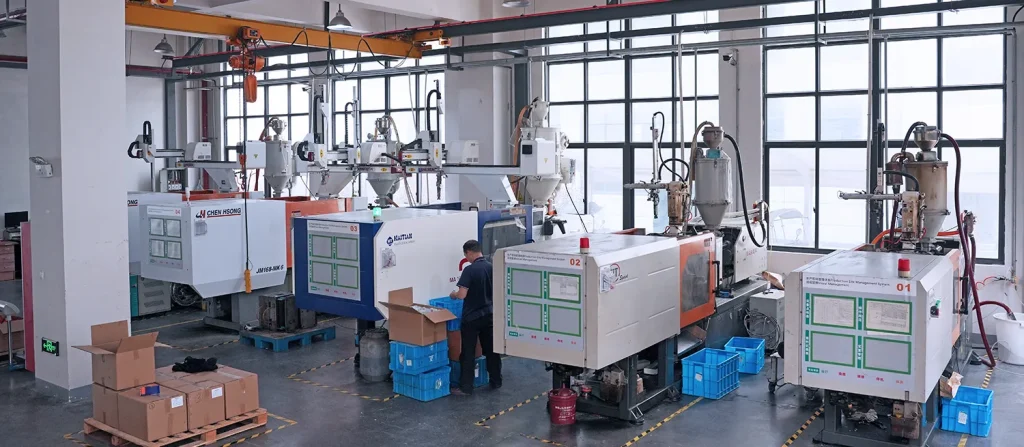
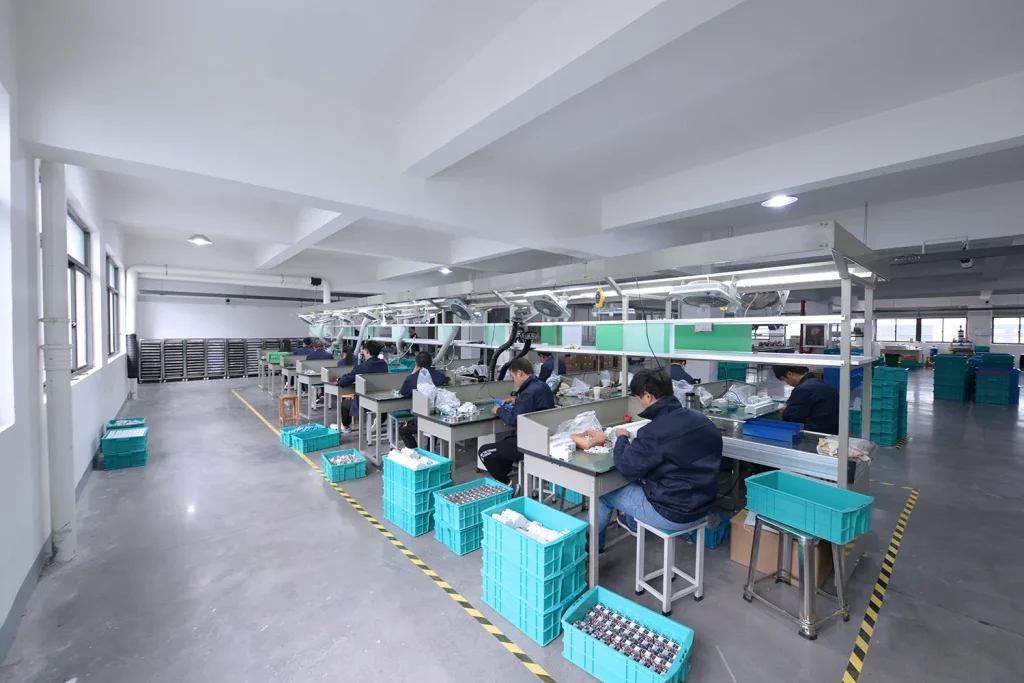
As a trusted manufacturer of surge protection devices in China, we specialize in delivering high-quality SPDs. With a deep understanding of industry standards and regulations, we produce millions of DC surge protection devices (DC SPD) annually to ensure the reliability and longevity of your PV system.
DC Surge Protection Device SPD Types
DC Surge Protection Devices (SPD) for Photovoltaic (PV) Solar Panel Inverters
According to IEC 61643-31:2018 and EN 61643-31:2019 (which replaces EN 50539-11:2013), there are two distinct types of DC surge protection devices (SPD) designed for photovoltaic (PV) solar panel inverters.
Type 1+2 / Class I+II / Class B+C:
Type 1+2 / Class I+II / Class B+C: Provides protection against direct lightning strikes and high-energy surges.
Type 2 / Class II / Class C:
Designed for use in distribution boards to protect against medium energy surges.

Type 1+2 DC Surge Protection Device SPD
DC SPD for Photovoltaic PV Solar Panel Inverter -OBV5-B50-PV series
Type 1+2 DC Surge Protection Device (SPD) for Photovoltaic (PV) Systems up to 1800 V DC, Facilitates the replacement of the protective element (MOV), providing ease of maintenance and cost savings.
This device offers reliable surge protection for photovoltaic systems, with independent safety testing and CE approval.
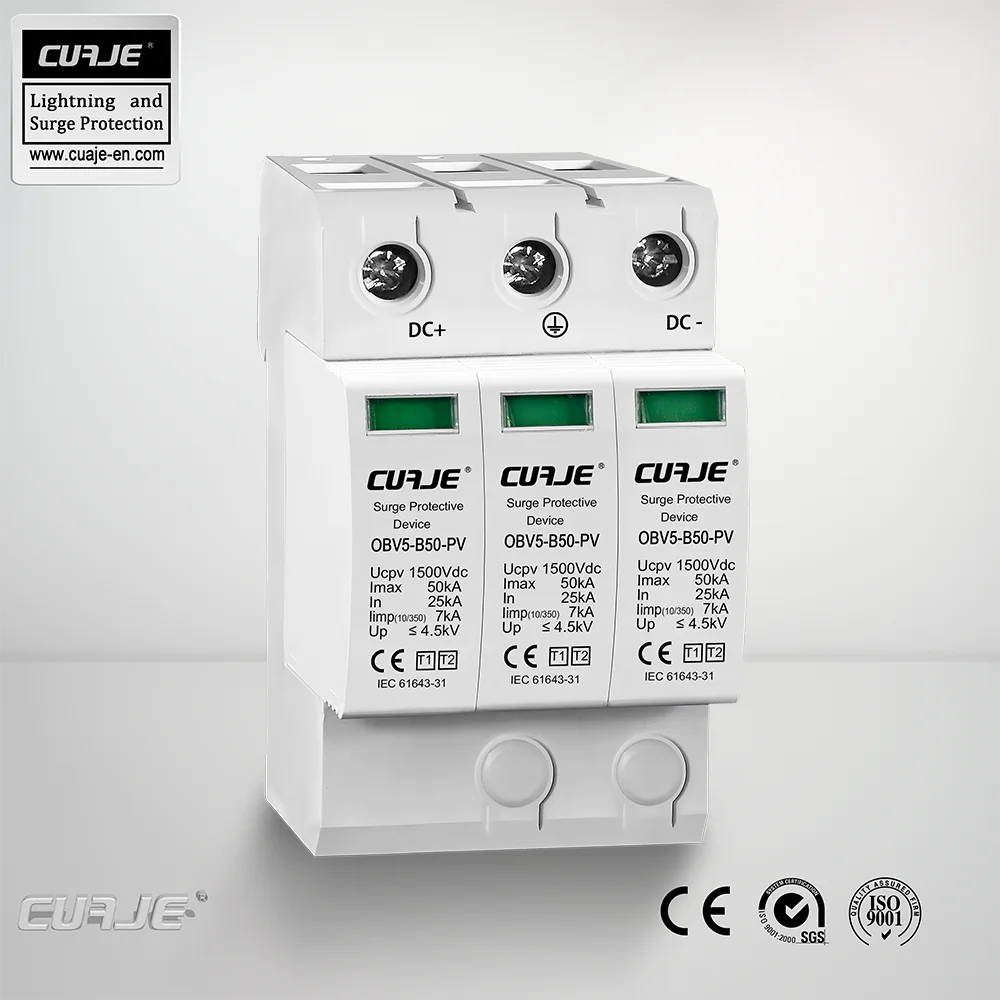
OBV5-B50-PV-1500Vdc/3P
Type 1+2 SPD for1500V DC

OBV5-B50-PV-1000Vdc/3P
Type 1+2 SPD for1000V DC

OBV5-B50-PV-800Vdc/3P
Type 1+2 SPD for 800V DC
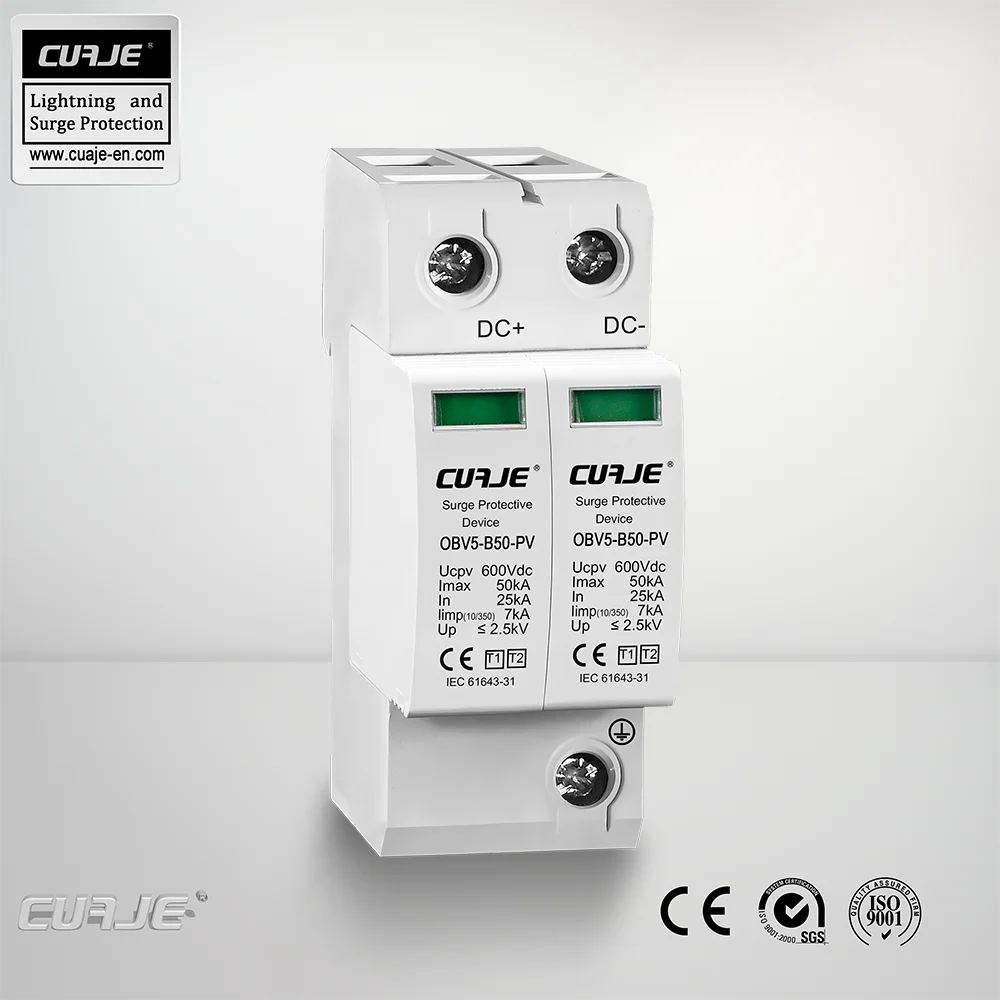
OBV5-B50-PV-600Vdc/2P
Type 1+2 SPD for 600V DC
Type 1+2 Solar Surge Protection Device SPD
DC SPD for Photovoltaic PV Solar Panel Inverter -OBV5-B50-PV series
The OBV5-B50-PV series Type 1+2 DC Surge Protection Device (SPD) is specifically designed for areas with high lightning activity, exceptional operational reliability, enabled by a short-circuit current rating of up to 1000 A.
Specification:
Max. continuous operating voltage Ucpv: 600V 800V 1000V 1500V 1800V
Type 1+2 / Class I+II / Class B+C
Impulse discharge current (10/350 μs) Iimp = 7kA @ Type 1
Nominal discharge current (8/20 μs) In = 25kA @ Type 2
Maximum discharge current (8/20 μs) Imax = 50kA @ Type 2
Protective elements: Metal Oxide Varistor (MOV)

Wiring Diagram & Installation
DC SPD for Photovoltaic PV Solar Panel Inverter -OBV5-B50-PV series
The OBV5-B50-PV series solar surge protection device (SPD) utilizes Metal Oxide Varistor (MOV) circuits to safeguard electrical equipment from power spikes in alternating current.
The Type 1+2 PV solar DC surge protection device SPD features a monoblock housing design and is offered with or without a floating remote indication contact.
Type 2 DC Surge Protection Device SPD
Pluggable DC SPD for Photovoltaic PV Solar Panel Inverter – OBV5-C40-PV Series
This Type 2 DC surge protection device (SPD) is designed for isolated DC voltage systems with ratings of 600V, 1000V, 1200V, 1800V, and 1800V DC, offering a short-circuit current rating of up to 1000 A.
The Type 2 SPD is built to withstand an 8/20 µs lightning current waveform.
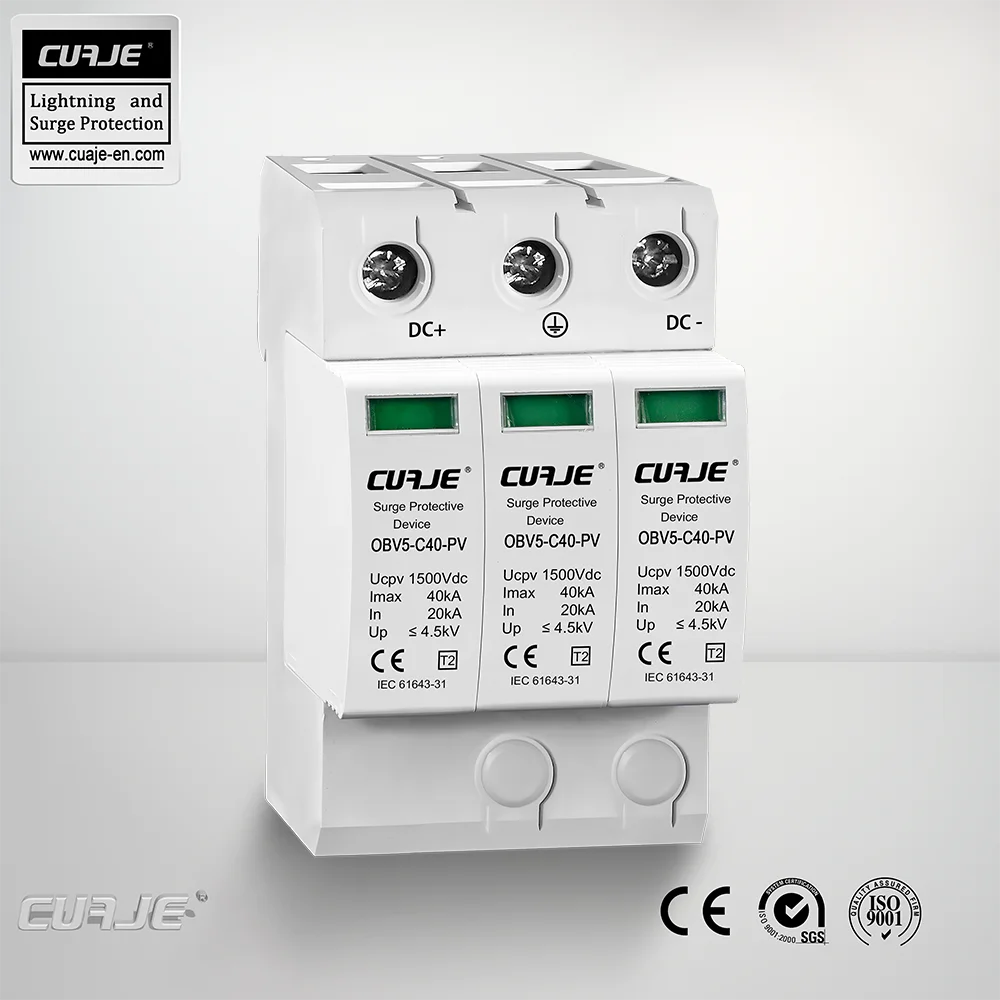
OBV5-C40-PV-1500Vdc/3P
Type 2 SPD for1500V DC
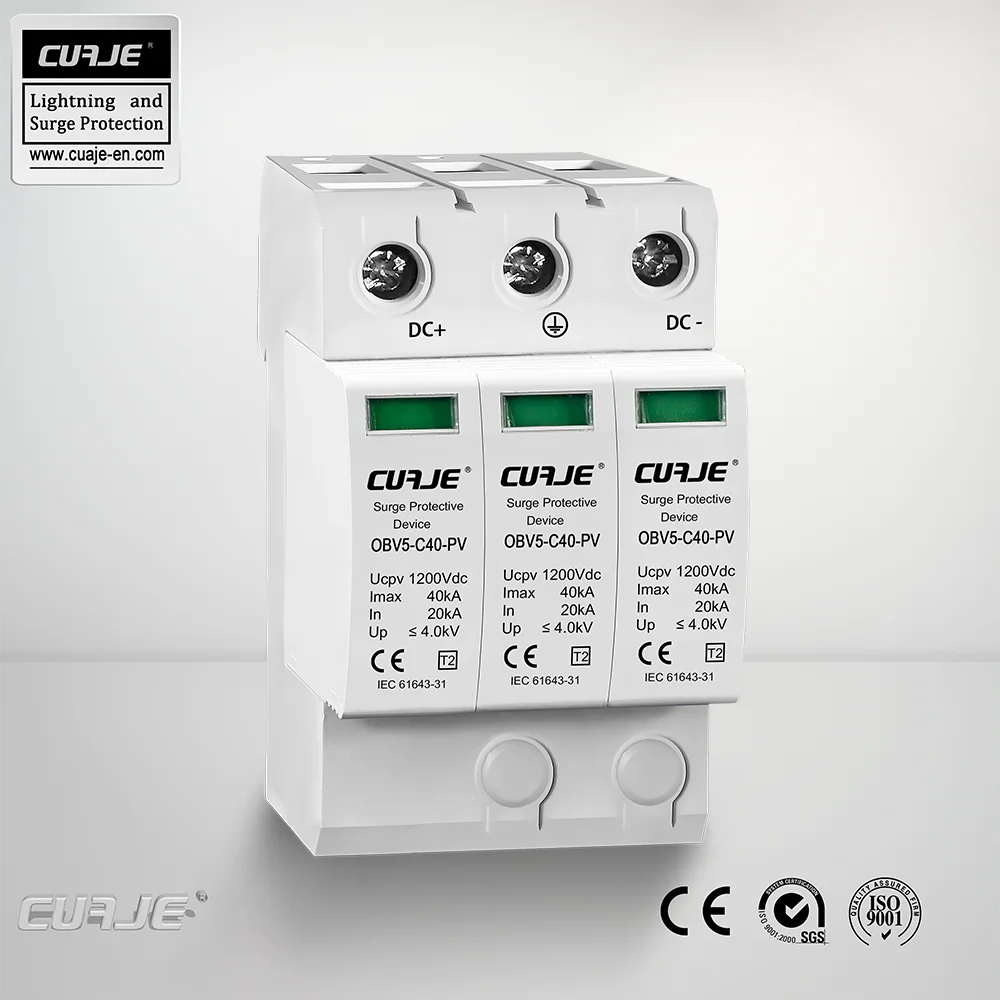
OBV5-C40-PV-1200Vdc/3P
Type 2 SPD for1200V DC

OBV5-C40-PV-1000Vdc/3P
Type 2 SPD for 1000V DC

OBV5-C40-PV-800Vdc/3P
Type 2 SPD for 800V DC

OBV5-C40-PV-900Vdc/2P
Type 2 SPD for 900V DC

OBV5-C40-PV-1000Vdc/2P
Type 2 SPD for 1000V DC

OBV5-C40-PV-800Vdc/2P
Type 2 SPD for 800V DC
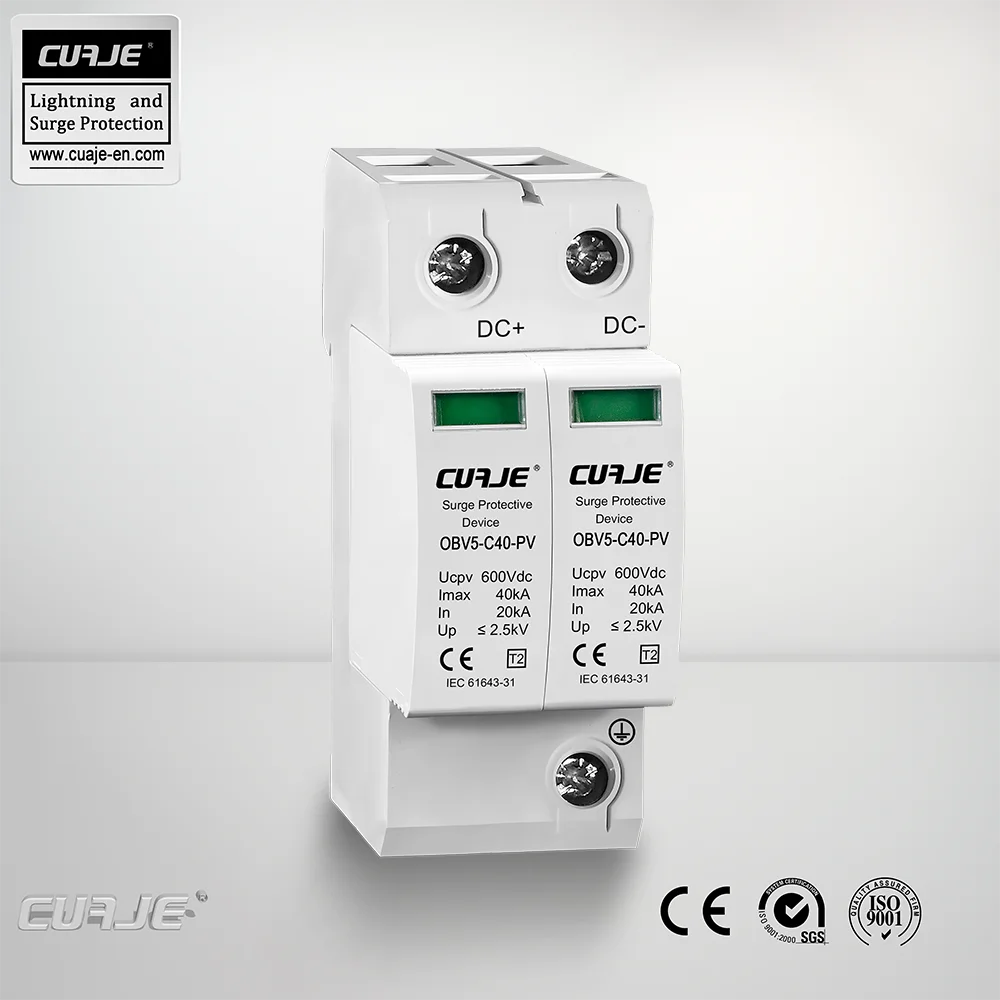
OBV5-C40-PV-600Vdc/2P
Type 2 SPD for 600V DC

OBV5-C40-PV-500Vdc/2P
Type 2 SPD for 500V DC
Type 2 AC Surge Protection Device SPD
DC SPD for Photovoltaic PV Solar Panel Inverter – OBV5-C40-PV Series
The housing of the DIN-Rail Type 2 DC surge protection device (SPD) features a pluggable design.
Specification:
Max. continuous operating voltage Ucpv: 500V 600V 1000V 1200V 1500V 1800V
Type 2 / Class II / Class C
Nominal discharge current (8/20 μs) In = 20kA @ Type 2
Max discharge current (8/20 μs) Imax = 40kA @ Type 2
Protective elements: Metal Oxide Varistor (MOV)
Wiring Diagram & Installation
DC SPD for Photovoltaic PV Solar Panel Inverter – OBV5-C40-PV Series
The Type 2 solar DC surge protection device (SPD) OBV5-C40-PV series is suitable for indoor use or can be installed in a waterproof enclosure for outdoor applications.
Type 2 DC Surge Protection Device SPD
Pluggable DC SPD for 12V 24V 48V 75V 95V 110V 130V 220V 280V 350V- OBV5-C40-DC Series
CUAJE has developed a comprehensive line of DC surge protection devices (SPDs) designed to safeguard equipment connected to DC power systems from surge damage caused by lightning.

OBV5-C40-DC-24Vdc/2P
Type 2 SPD for 24V DC

OBV5-C40-DC-48Vdc/2P
Type 2 SPD for 48V DC
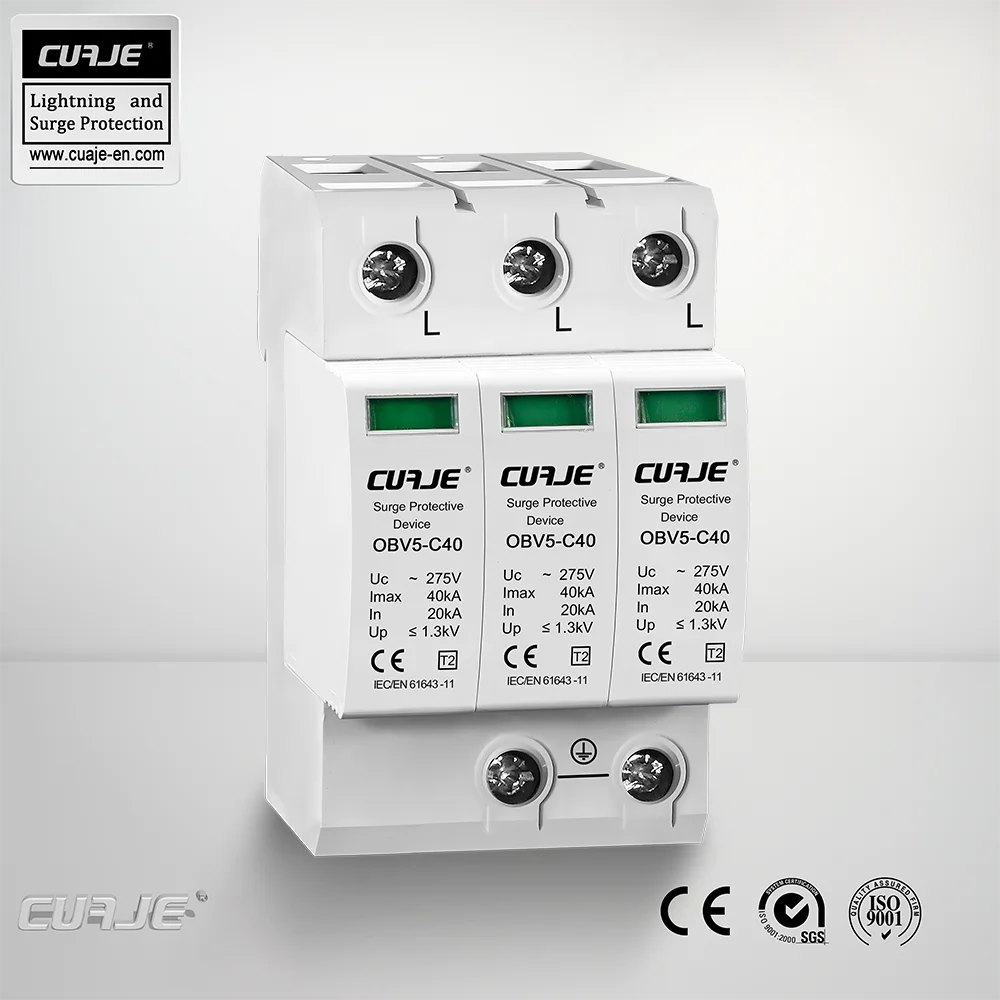
OBV5-C40-DC-75Vdc/2P
Type 2 SPD for 75V DC

OBV5-C40-DC-110Vdc/2P
Type 2 SPD for 110V DC

OBV5-C40-DC-220Vdc/2P
Type 2 SPD for 220V DC
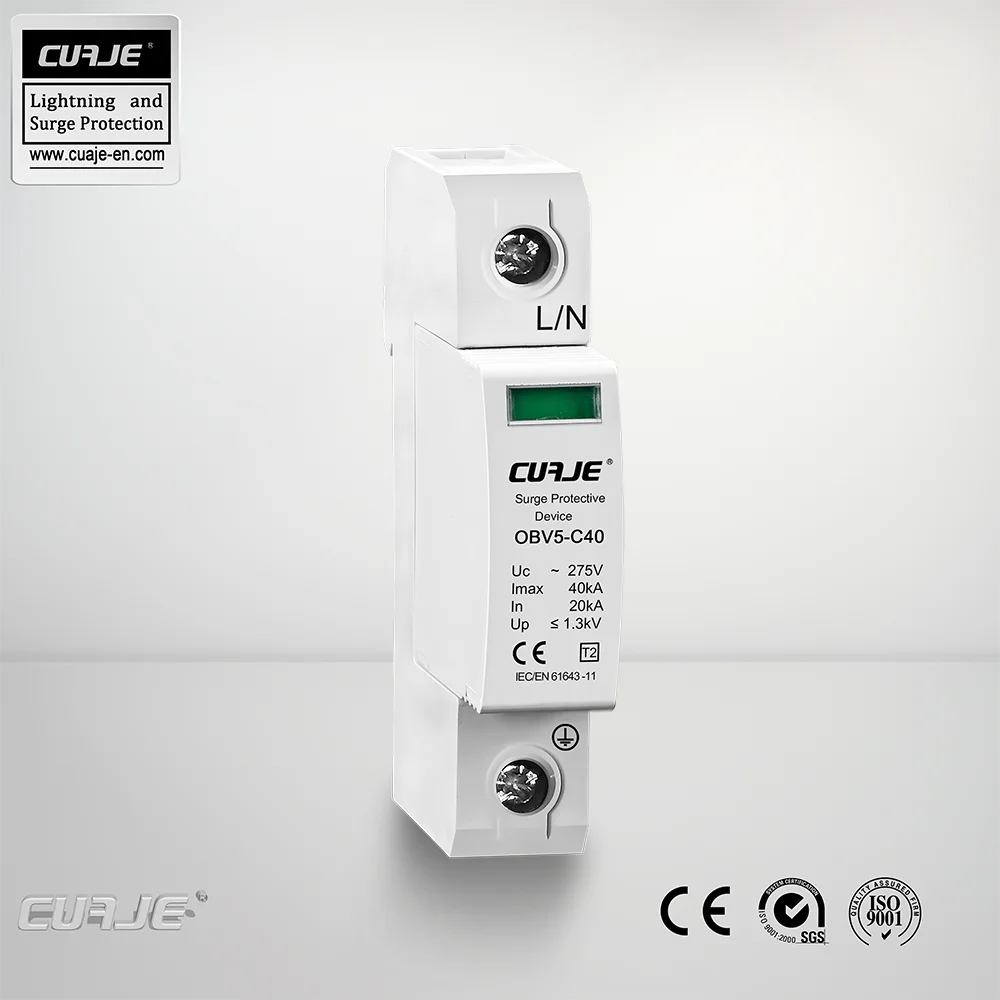
OBV5-C40-DC-350Vdc/2P
Type 2 SPD for 350V DC
Type 2 DC Surge Protection Device SPD
Pluggable DC SPD for 12V 24V 48V 75V 95V 110V 130V 220V 280V 350V- OBV5-C40-DC Series
The DIN-Rail Type 2 DC surge protection device SPD OBV5-C40-DC series is designed for indoor use or can be installed in a waterproof box for outdoor applications.
This Type 2 DC surge protection device (SPD) can either include or exclude remote signaling.
Specification:
Nominal working voltage Un: 12V, 24V, 48V, 75V, 95V, 110V, 130V, 220V, 280V, 350V
Type 2 / Class II / Class C
Nominal discharge current (8/20 μs) In = 20kA @ Type 2
Max discharge current (8/20 μs) Imax = 40kA @ Type 2
Protective elements: Metal Oxide Varistor (MOV)
Wiring Diagram & Installation
Type 2 DC Surge Protection Device SPD
Pluggable DC SPD for 12V 24V 48V 75V 95V 110V 130V 220V 280V 350V- OBV5-C40-DC Series
The housing of the DIN-Rail Type 2 DC surge protection device SPD features a pluggable design.
DC Surge Protection Device SPD for Solar Photovoltaic (PV) Inverters
Surge Protective Devices (SPDs) offer protection against electrical surges and spikes, including those caused directly or indirectly by lightning.
In areas with frequent lightning, unprotected PV systems are at risk of suffering repeated and severe damage. This results in substantial repair and replacement costs, system downtime, and loss of revenue.
Properly installed SPDs can help minimize the impact of lightning events on the system.
Sensitive equipment in PV systems, such as AC/DC inverters, monitoring devices, and the PV array itself, must be safeguarded with SPDs.
Correct Sizing of a Surge Protective Device (SPD) for Your Power System:
An SPD is designed to prevent high energy voltage peaks from reaching sensitive equipment, which could otherwise cause damage.
When correctly designed, how does an SPD work in a DC system?
Excess voltage (beyond the equipment’s rating) is prevented from accumulating by controlled energy discharge between the affected DC or AC conductors.
If a ground connection is present on the SPD, it will also monitor the voltage differential between the ground and other conductors.
If necessary, the SPD discharges energy to prevent excessive voltage differences, such as those during a surge event. For this to work effectively, the path to the ground must have low resistance.
However, SPDs cannot protect against prolonged over-voltage lasting several seconds or minutes. This must be prevented by proper system sizing.
Steps to Protect Your Equipment from Voltage Surges:
Ensure that both your system and SPD have a reliable, low-resistance connection to the ground.
Select an SPD that matches the inputs of the power conversion equipment you wish to protect. Ensure that the SPD’s “Uc” voltage rating (as specified in the datasheet) is at or just slightly above (preferably 0 to 10 V) the maximum continuous voltage on the conductors being protected, or the maximum voltage rating of the connected power equipment.
If the SPD’s “Uc” rating is too high compared to the power equipment’s maximum voltage rating, it will no longer provide effective protection against voltage surges. The SPD will only activate above the maximum continuous operating voltage “Uc,” and will not intervene at voltages below “Uc.”
It is recommended to protect at least the PV input of the charge controller or inverter/charger. If connected to a public electric grid, protect the AC input as well.
If used on the PV conductors, ensure the SPD is rated for DC voltages; if used on the AC input, ensure the SPD is rated for AC voltages.
How Surge Protection Devices Reduce Downtime in Photovoltaic Plants:
SPDs help minimize downtime caused by surges. In PV plants, these devices must meet specific requirements to ensure continuous operation and optimal energy generation.
When designing a PV plant, it is critical to account for the installation of SPDs. Surges and network disturbances can lead to downtime, which in turn reduces plant performance. All factors affecting energy generation and distribution should be taken into consideration during the design of the electrical system.
Why Surge Protective Devices Are Essential in PV Plants:
Solar panels are installed outdoors to harness solar energy. Due to this outdoor environment, they are directly exposed to harsh conditions such as rain, wind, and dust. Among these weather challenges, lightning strikes require special attention, as they can severely compromise both the safety and performance of a PV plant.
Lightning originates in cumulonimbus clouds and discharges to the ground. Upon hitting the ground, the lightning releases energy, affecting the electrical field in its vicinity. For PV plants, this poses two key risks:
Direct Impact: A lightning strike can physically damage solar equipment, such as rooftop panels.
Transient Overvoltages: These overvoltages pass through cables via magnetic coupling, potentially damaging sensitive components like printed circuit boards (PCBs).
For direct impacts, External Lightning Protection (ELP) is required according to IEC 62305. This standard outlines how to assess whether your location needs protection and provides guidance on preferred protection options (such as meshed cages or air terminals).
The concept is straightforward: ensure that lightning strikes a metallic rod placed at the highest point of the PV plant, and direct the energy safely to the ground through a copper down conductor.
For transient overvoltages, however, SPDs are necessary. These devices are installed in parallel to the circuit protection boards, diverting the excess energy to the ground and limiting overvoltage to a level safe for the connected equipment.
Once an ELP is installed at a PV plant, it is mandatory to install an SPD as well. If the PV plant lacks an ELP, the installation of an SPD is strongly recommended to mitigate network disturbances (transient overvoltages).
How an SPD Protects the DC Side of Solar Plants
To effectively limit overvoltages and ensure energy flows safely to the ground, the key component in surge protection devices (SPDs) is the Metal Oxide Varistor (MOV).
In normal operating conditions, the MOV has a high resistance, preventing any nominal current from passing through it. However, when an overvoltage occurs, the MOV’s resistance drops rapidly, creating a pathway to ground, and the system returns to normal once the excess energy is dissipated.
This process ensures that the overvoltage level reaching downstream equipment is limited, preventing potential damage.
Type 1+2 SPD vs Type 2 SPD: Which One is Right for You?
Surge protective devices (SPDs) come in various types, including Type 1, Type 2, and Type 1+2, each with different resistance capabilities. A Type 1 SPD can handle a direct lightning strike and the associated surge energy, while a Type 2 SPD limits overvoltages caused by various sources. A Type 1+2 SPD combines both features for comprehensive protection.
In photovoltaic (PV) plants, selecting the right SPD is critical to withstanding powerful surge currents (e.g., 10/350 µs waveform, which is nearly ten times stronger than the 8/20 µs waveform of Type 2). Space is often limited in inverters and junction boxes, so it’s crucial to maximize available space while still offering robust protection.
The FLP-PV and SLP-PV series provide overvoltage protection for both AC and DC circuit protection boards in solar installations, safeguarding them from lightning strikes and network disturbances.
Why Solar Systems Need Surge Protection: Lightning and Overvoltages
Like all electronic devices, solar arrays are vulnerable to voltage surges that can damage components and lead to downtime. Surge protection devices help ensure systems continue to operate efficiently and profitably.
A surge protector diverts excess electricity from the “hot” power line to a grounding wire, typically using a metal oxide varistor (MOV), which is connected to the power and grounding lines.
The Need for Surge Protection in Solar Panels
Solar panels, being electronic devices, are prone to the same surge-related damage as other electronics. Because of their large surface area and placement in exposed locations, solar panels are particularly susceptible to lightning strikes.
Direct lightning strikes can cause severe damage, such as burning holes or even explosions, destroying the entire system. Secondary effects, such as transient overvoltages, can also damage sensitive components like inverters, modules, and monitoring systems.
Loss of a PV module may only affect one string of panels, but the failure of a central inverter can result in a significant loss of power generation across large sections of the plant.
Installing Surge Protection Devices (SPDs)
Since all electrical equipment is vulnerable to surges, SPDs are necessary for all components in a solar array. These industrial-grade devices also incorporate metal oxide varistors (MOVs) to direct surge energy safely to the ground.
For proper installation, begin by ensuring a stable grounding system. Then, cascade SPDs from the utility service to the array equipment, placing robust protection at major points of entry to safeguard against large surge transients, and use smaller devices along critical paths to protect sensitive equipment.
An SPD network should be installed across the solar array’s AC and DC power distribution, with protection on both DC inputs and AC outputs of inverters. Protection should also extend to all power conductors, including positive and negative DC lines, as well as combiner circuits, control systems, and monitoring devices.
For commercial and utility-scale systems, the 10m rule is recommended: for DC cable lengths under 10 meters, install surge protection near the inverter or combiner boxes, and for lengths over 10 meters, protection should be installed at both the inverter and module ends.
In residential systems with microinverters, which have short DC cabling but longer AC cables, an SPD should be installed at the combiner box for array surge protection and at the main panel to protect the home from both array and utility surges.
To maximize safety and effectiveness, SPDs should be installed by a licensed electrician in compliance with manufacturer recommendations and electrical codes.
Additional Protection: Lightning Air Terminals
While SPDs protect against transient overvoltages, they cannot prevent damage from direct lightning strikes. To further protect a solar array from lightning, consider adding lightning air terminals, which help divert lightning strikes away from the system.
SPD for Photovoltaic Applications: Overvoltage Causes
Overvoltage can arise in electrical systems due to several factors:
Lightning strikes (directly or nearby, including on buildings or lightning conductors).
Variations in the electrical field caused by lightning or network disturbances.
Given that PV installations are outdoor structures, they face a heightened risk of lightning, which varies by region. Therefore, preventive and arresting systems and devices should be implemented to protect the system.
Equipotential Bonding: The First Safeguard
Equipotential bonding ensures that all grounded conductors and metal parts within the PV installation are bonded to create an equal potential across the system. This safeguard helps prevent damaging voltage differences and should be the first protection step in any installation.
Installing Surge Protection Devices (SPD)
The installation of SPDs on the DC side depends on the cable length between the solar panels and the inverter. If the distance is less than 10 meters, an SPD should be installed near the inverter. For distances exceeding 10 meters, a second SPD is required and should be placed near the solar panel, with the first SPD remaining at the inverter area.
For optimal performance, SPD connection cables to the L+ / L- network, as well as the cables between the SPD’s earth terminal block and the ground busbar, should be as short as possible—ideally under 2.5 meters (d1+d2 < 50 cm).
Safe and Reliable Photovoltaic Energy Generation
To ensure proper protection for both the “generator” and “conversion” sections, multiple surge arresters may be required, depending on the distance between these two parts. This helps to guarantee the safety of each section.
Surge Protection for Photovoltaic Systems – Overview
When a photovoltaic (PV) system is installed on an industrial site, not only is the system at risk, but so is the business’s operations and equipment. While inverters are costly, the greater financial risk in industrial applications is the downtime caused by system failure.
Lightning strikes to a solar PV system induce transient currents and voltages within the system’s wiring loops. These surges can reach the equipment terminals, leading to insulation and dielectric failures in critical components such as PV panels, inverters, control systems, communication devices, and other electrical equipment in the building installation.
The array box, inverter, and Maximum Power Point Tracker (MPPT) are the primary failure points.
To avoid high-energy surges from damaging the PV system’s electronics, it’s crucial that voltage surges have a safe path to ground. This can be achieved by grounding all conductive surfaces and ensuring that all system wiring (e.g., Ethernet and AC mains cables) is connected to ground through a surge protection device (SPD).
Each string group within the array box, the combiner box, and the DC disconnect require an SPD for adequate protection.
While height, pointed shapes, and isolation factors influence where lightning strikes, it’s a misconception that metal attracts lightning. Regardless of the PV farm’s location or nearby object shapes, SPDs are essential in every PV system due to their vulnerability to both direct and indirect lightning strikes.
Surge Protection Device Selection and Installation for PV Systems
Due to the unique characteristics of PV systems, SPDs specifically designed for these systems are required.
PV systems can operate at DC system voltages as high as 1500 volts, and their maximum power point operates near the system’s short circuit current. To select the correct SPD module and installation for a PV system, the following factors must be considered:
Lightning flash density in the area
The system’s operating temperature
The system’s voltage
The system’s short circuit current rating
The type of surge to be protected against (direct or indirect lightning)
The nominal discharge current
For systems protected by an external lightning protection system (LPS), SPD requirements will depend on the LPS class and whether the separation distance between the LPS and the PV system is isolated or non-isolated. IEC 62305-3 outlines the separation distance requirements for an external LPS.
For effective protection, the SPD’s voltage protection level (Up) should be at least 20% lower than the dielectric strength of the system’s terminal equipment.
It’s essential to choose an SPD with a short circuit withstand current greater than the short circuit current of the solar array string it protects.
Additionally, the SPD connected to the DC output should have a DC MCOV (Maximum Continuous Operating Voltage) equal to or greater than the maximum system voltage of the photovoltaic panel.
When lightning strikes at point A (as shown in Figure 1), both the solar PV panel and the inverter are at risk of damage. However, if the lightning strike occurs at point B, only the inverter is likely to be affected.
The inverter, being one of the most expensive components of a photovoltaic (PV) system, requires particular attention when selecting and installing surge protection devices (SPDs) for both the AC and DC lines. The closer the lightning strike is to the inverter, the more severe the damage is likely to be.
Surge Protection Device (SPD) for the DC Side of Photovoltaic Systems
PV systems behave differently from traditional DC sources, exhibiting non-linear characteristics and the potential for long-term persistence of ignited arcs. Due to this, PV current sources demand more robust switches and fuses, as well as a disconnector specifically designed to handle these unique currents in surge protective devices.
SPDs installed on the DC side of PV systems must be specifically designed for DC applications. Using an SPD intended for AC or DC on the wrong side can be dangerous under fault conditions.
When SPDs are employed on the DC side, it’s equally important to use SPDs on the AC side to account for potential differences between the two.
Surge Protection Device (SPD) for the AC Side
Surge protection on the AC side is just as crucial as on the DC side. Ensure that the SPD used is specifically designed for the AC system.
For maximum effectiveness, the SPD should be appropriately sized for the system. Correct selection will ensure optimal protection and the longest possible lifespan for the SPD.
On the AC side, if multiple inverters are connected to the same grid, they can share the same SPD, as long as the connection to the grid is common.
Installing Surge Protection Devices (SPDs)
SPDs should always be installed upstream of the devices they are intended to protect. According to NFPA , surge protection must be installed on the DC output of the solar panels (from both positive to ground and negative to ground), at the combiner and combiner box for multiple panels, and at the AC output of the inverter.
Proper SPD installation depends on three key values:
Maximum Continuous Operating Voltage (MCOV): This is the voltage at which the SPD activates.
Voltage Protection Level (Up): The SPD’s protection level must be lower than the overvoltage category of the equipment it is protecting.
Nominal Discharge Current: This refers to the peak value of the waveform (8/20 μs for type 2 SPDs) that the SPD is designed to withstand after repeated surges.
Cables in PV Systems
In photovoltaic (PV) systems, cables are often run over long distances to connect to the grid. However, it is not recommended to use long cable lengths, as this increases the risk of electrical interference caused by lightning strikes, both through field-based and conducted effects.
When a transient overvoltage occurs, any inductive voltage drop in the connecting cables can reduce the effectiveness of the surge protection device (SPD). This issue can be minimized by keeping the cable lengths as short as possible.
Surge voltages are a primary cause of cable failure, and each surge event degrades the cable’s insulation, reducing its longevity.
For standalone PV systems (systems far from the grid), lightning surges can disrupt equipment powered by solar energy, such as medical devices or water supply systems.
The number and placement of SPDs on the DC side of a PV system depend on the distance between the solar panels and the inverter (as shown in the accompanying table).
If the cable length is less than 10 meters, only one SPD is required, and it should be installed near the inverter.
If the cable length exceeds 10 meters, install one SPD near the inverter and another one close to the solar panel.
To minimize interference, route the cables in a way that avoids large conductor loops. Both AC and DC lines, as well as data lines, should be routed together with the equipotential bonding conductors along the entire route to prevent loops from forming, especially when connecting the inverter to the grid.
Important Note:
The cable connecting an SPD to the load should always be as short as possible and never exceed 10 meters. If the length exceeds this, a second SPD is required. The greater the cable length, the more significant the reflection of lightning waves, which increases the risk.
Combining SPDs with Inverters
PV farms rely on highly sensitive equipment that requires extensive protection. Inverters, which convert the direct current (DC) from the PV panels into alternating current (AC) for grid use, are essential but highly vulnerable to lightning strikes. Since inverters are also expensive, proper surge protection is crucial.
According to NFPA 780 12.4.2.3, if the system inverter is located more than 30 meters from the nearest combiner or combiner box, additional SPDs should be installed at the DC input of the inverter.
If string protectors (such as fuses, DC breakers, or string diodes) are in place, the SPD should be installed between the fuses and the inverter to protect against surges effectively.
Figure 2 illustrates the correct and incorrect methods of connecting an SPD to the inverter with string protectors.
When connecting an SPD to an inverter with an integrated fuse box, ensure that the internal fuses are bypassed and the external string fuses are properly connected (as shown in Figure 3). The SPDs should be mounted externally to the inverter and housed in a NEMA Type-3R enclosure or higher, especially for outdoor applications.
Figure 3 – SPD connection to an inverter with an integrated fuse box
String inverters should be installed as close to the strings as possible. The SPD cables connecting to the L+/L- network, as well as those between the SPD’s terminal block and the ground busbar, should not exceed 2.5 meters in length.
Shorter connection cables enhance both the efficiency and cost-effectiveness of surge protection. For inverters with a single MPP tracker, combine the strings before the inverter and connect them to the SPD at the interconnection point.
When the inverter has multiple MPP trackers, SPD combinations should be planned for each individual input. An SPD must be installed for each input that is fused with a string diode.
Conclusion
Operating photovoltaic equipment without proper surge protection is not just risky, it is irresponsible.
For solar systems to contribute to a greener future, robust protection is essential.
Since lightning strikes are unavoidable, protecting against them is crucial.
Given the vulnerability of photovoltaic systems to both direct and indirect lightning strikes, it is imperative that they are equipped with reliable, well-installed surge protection.
Type 1 Surge Protection Device (SPD)
Iimp: Impulse Current
The peak current value of a 10/350 µs waveform that the Surge Protection Device (SPD) is capable of discharging at least one time.
Iimp is important because the IEC 62305 standard mandates a maximum impulse current of 25 kA per pole for three-phase systems. For a 3P+N network, the SPD should withstand up to a total 100 kA impulse current from earth bonding.Ifi: Autoextinguish Follow Current
This applies to SPDs using spark gap technology. It is the current (50 Hz) that the Surge Protection Device (SPD) can interrupt by itself after a flashover. This current must always exceed the prospective short-circuit current at the installation point.
Type 2 Surge Protection Device (SPD)
Imax: Maximum Discharge Current
The peak value of a current with an 8/20 µs waveform that the Surge Protection Device (SPD) can discharge once.
Imax is significant because, when comparing two SPDs with the same In, the one with the higher Imax value offers a greater safety margin and can handle higher surge currents without sustaining damage.
Type 3 Surge Protection Device (SPD)
Uoc: Open-Circuit Voltage
The open-circuit voltage applied during Type 3 (Class III) Surge Protection Device (SPD) tests.
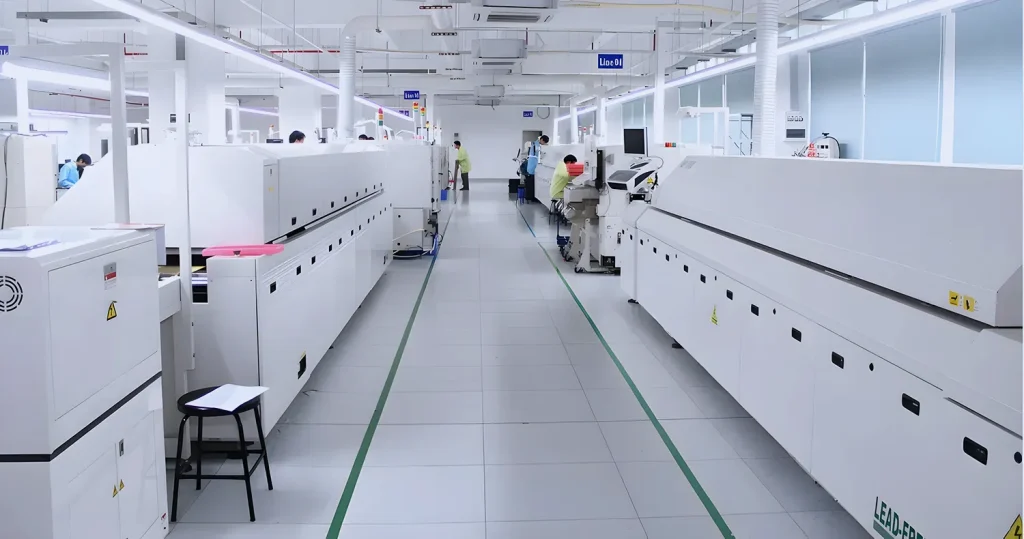
Contact CUAJE for Custom Surge Protection Devices
If you need surge protection tailored to your specific application, contact us today. Our team of experts is ready to help design a solution that will effectively protect your electrical systems.